
Semantic SEO guide
What Is Semantic SEO? Meaning, Examples and How to Do It

Short answer
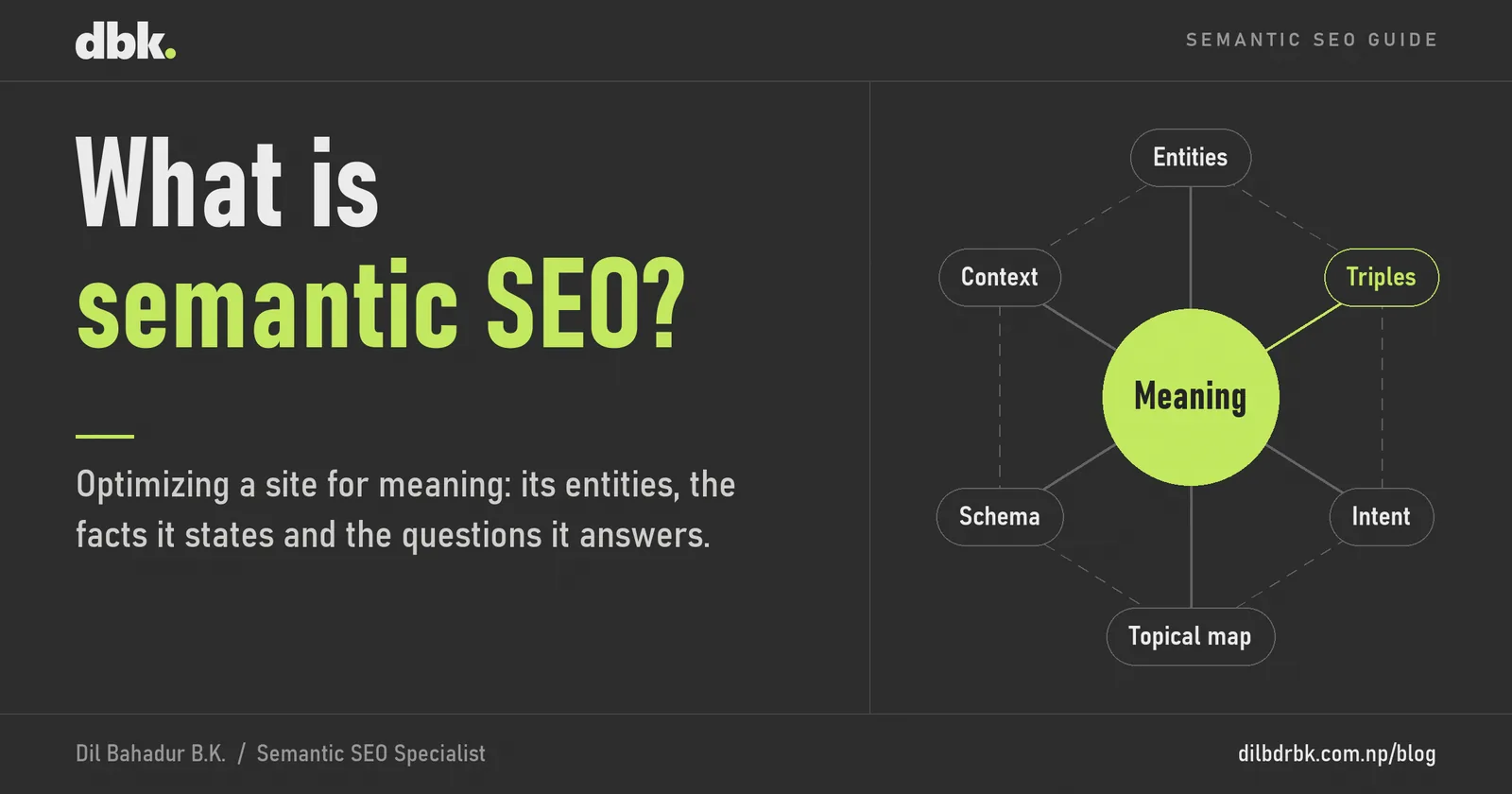
Semantic SEO is the practice of optimizing a website for meaning, so search engines understand the entities a page covers, the facts it states about them and the questions it answers. It replaces one keyword per page with a connected network of pages, each answering one intent in clear, fact-based sentences. [[/answer]]
Semantic SEO matters because Google's ranking systems read meaning, not only matching words. Google's guide to its ranking systems describes current AI systems that interpret language and page sections, such as RankBrain, neural matching, BERT and passage ranking.
In this guide
What Is Semantic SEO?
Semantic SEO is an approach to search engine optimization that builds a website around topics, entities and their relations instead of isolated keywords. A semantic SEO page answers the question behind a search, connects the related concepts a reader expects next and links to pages that cover each of those concepts in depth.
Koray Tugberk Gubur of Holistic SEO describes semantic SEO as building a meaningful content network for every entity within a subject, with factual accuracy and relevance between the terms, entities and facts. His framing puts meanings and topics ahead of single words, so a connected content network, not one page, earns relevance for a subject.
The Meaning in Plain Words
In plain words, semantic SEO means covering a topic the way an expert would explain it. A guide to running shoes for flat feet, for example, names the conditions involved, such as overpronation and fallen arches. It also names the features that help, such as arch support, and the people who advise on them, such as podiatrists.
A keyword-first page repeats "running shoes for flat feet" in every heading and stops there. The semantic version answers the follow-up questions a runner asks next, such as how to test arch height or when to replace a shoe. It links to the pages that answer them in full.
Semantic Search vs Semantic SEO
Semantic search is the search engine's side: Holistic SEO defines it as search behavior that relies on the meanings of concepts, words and sentences. Google builds that ability with its language systems, and no website controls it.
Semantic SEO is the website's side. It shapes content, structure and markup so a semantic search engine can read the meaning quickly and match the page to the right searches. In short, semantic search interprets meaning, and semantic SEO makes the meaning easy to interpret.
How Google Reads Meaning, and Why Semantic SEO Follows It
Google reads meaning through several AI and knowledge systems, and semantic SEO exists because those systems reward pages whose meaning is clear. Google's guide to its ranking systems, updated 10 December 2025, describes the systems that interpret language and concepts.
| Google system | What Google says it does (ranking guide or launch post) | What it means for semantic SEO |
|---|---|---|
| Knowledge Graph (launched 16 May 2012) | Stores facts about entities, introduced as "things, not strings" | Name entities clearly and state their facts consistently |
| Hummingbird (August 2013) | A major improvement to the overall ranking systems, now retired | The shift from strings to meaning started more than a decade ago |
| RankBrain | Helps Google understand how words relate to concepts, even when a page lacks some of the exact words in the search | Cover the concept fully, not one phrasing of it |
| Neural matching | Understands representations of concepts in queries and pages and matches them | Write about the underlying concept, in the reader's language |
| BERT (announced 25 October 2019) | Understands how combinations of words express meaning and intent | Small words, such as "to" and "for", change meaning, so write precise sentences |
| Passage ranking | Identifies individual sections of a page to judge relevance | Each section must answer its own question |
| MUM | Understands and generates language, but Google says it is not currently used for general ranking | Treat MUM claims in SEO advice with care |
Google's BERT announcement shows the idea in one search. For "2019 brazil traveler to usa need a visa", earlier systems returned results about US citizens traveling to Brazil. BERT understood the word "to" and returned results for a Brazilian traveling to the US. Google said BERT would help with one in 10 searches in the US in English at launch.
These systems share one requirement: the page must say what it means. Semantic SEO turns that requirement into a working method, from the facts on each page to the links between pages.
Semantic SEO vs Traditional SEO
Semantic SEO and traditional SEO differ in the unit they optimize. Traditional SEO optimizes a page for a keyword, while semantic SEO optimizes a network of pages for a topic and its entities. The table compares the two approaches across the parts of an SEO project.
| Part of the project | Traditional SEO | Semantic SEO |
|---|---|---|
| Research unit | A keyword with search volume | A topic, its entities and the questions searchers ask |
| Page planning | One page per keyword | One page per intent, decided by a topical map |
| Writing | Keyword density and exact-match phrases | Answer-first sentences with clear subjects, predicates and facts |
| Related words | Synonyms added to reach more phrasings | Related concepts that complete the meaning, such as parts, types and causes |
| Structure | Isolated pages | Clusters joined by internal links with descriptive anchors |
| Markup | Optional | Schema markup that names the entities on each page |
| Success measure | Rankings for target keywords | Rankings across the query network, plus citations in AI answers |
Traditional SEO still matters: crawling, indexing, titles and links remain the foundation of every site. Semantic SEO builds on that foundation and changes how the content and the site structure are planned.
Semantic SEO vs Entity SEO
Entity SEO is one layer of semantic SEO: it focuses on the entities themselves, their attributes and their identity across the web. Semantic SEO covers that layer and adds the language layer, such as predicates, word relations and query intent, plus the site layer of topical maps and internal links.
The guide to entity SEO explains the entity layer in depth, from the Knowledge Graph to entity schema. The comparison of entity SEO and keyword SEO shows where the two meet in practice.
The Core Parts of Semantic SEO
Semantic SEO rests on 6 core parts: entities and attributes, triples, word relations, topical maps, source context and structured data. Each part makes the meaning of a page, or of a whole site, easier for search engines to read.
Entities, Attributes and Values
An entity is a distinct thing or concept, such as a person, a product or a place, and an attribute is a property of that entity with a value. A turbocharger, for example, has attributes such as condition, brand and engine fit, with values such as rebuilt, Garrett and Cummins.
Semantic SEO pages state these entity, attribute and value facts plainly, so a search engine can extract them without guessing. A page that lists attributes with real values reads as a reliable source, while a page of vague adjectives gives the engine nothing to store.
Triples and Positive Predicates
A triple is a fact written as subject, predicate and object, such as "a replacement turbocharger restores charge pressure". The predicate, usually a verb, carries the relation between the two entities, and Holistic SEO treats predicates as the central unit of meaning in a sentence.
Positive predicates describe what something does for the reader, such as "restores", "protects" or "lowers". Sentences built this way keep the subject close to its verb and object, which makes each fact easy to parse and easy for an AI answer to quote word for word.
Word Relations and Meaning
Word relations connect the vocabulary of a topic. Synonyms share a meaning, hypernyms name a broader class, hyponyms name a narrower type, and meronyms name a part of a whole, such as "compressor wheel" as a part of a turbocharger.
Holistic SEO separates semantic similarity from semantic relevance: two words are similar when one can replace the other, and relevant when they belong to the same context without being interchangeable. "Running" and "climbing", for example, are not similar, but they are relevant because both are done with shoes. A page uses relevant terms to complete the context and similar terms only where they fit naturally.
Topical Maps and Topical Authority
A topical map plans every page a site needs to cover a subject, from the central entity down to its attributes and the questions searchers ask. It decides which questions earn their own page and which belong as a section of a broader page.
Covering a topic this way builds topical authority, the trust a site earns when it covers a subject in depth and links the pages logically. The guide to creating a topical map walks through the method, and the comparison of topical authority and domain authority explains why depth outweighs a backlink score.
Source Context in Semantic SEO
Source context is the purpose of the website, the business it serves and the audience it targets, and it narrows a broad topic to the angle that matters for that site. The central entity is the main subject the whole site revolves around.
The same topic is written differently for different sources. A parts store writes about turbochargers for buyers who compare conditions and prices, while a repair school writes about them for students who learn how they work. Semantic SEO keeps every page aligned with one source context, so the site's meaning stays consistent.
Structured Data for Semantic SEO
Structured data is markup, usually in JSON-LD with the Schema.org vocabulary, that labels the entities and facts on a page. Google states that it uses structured data to understand the content of a page. Google also uses it to gather information about the web and the world, such as the people, books or companies in the markup.
Semantic HTML supports the same goal at the layout level. Elements such as main, nav and article mark which part of the page holds the main content, which helps a search engine separate it from navigation and supporting content.
How to Do Semantic SEO in 7 Steps
Semantic SEO follows 7 steps: define the source context, collect the query network, group queries by intent, plan the topical map, write answer-first content, mark up the entities, then measure and expand. The steps move from the business to the searcher and back to the site structure.
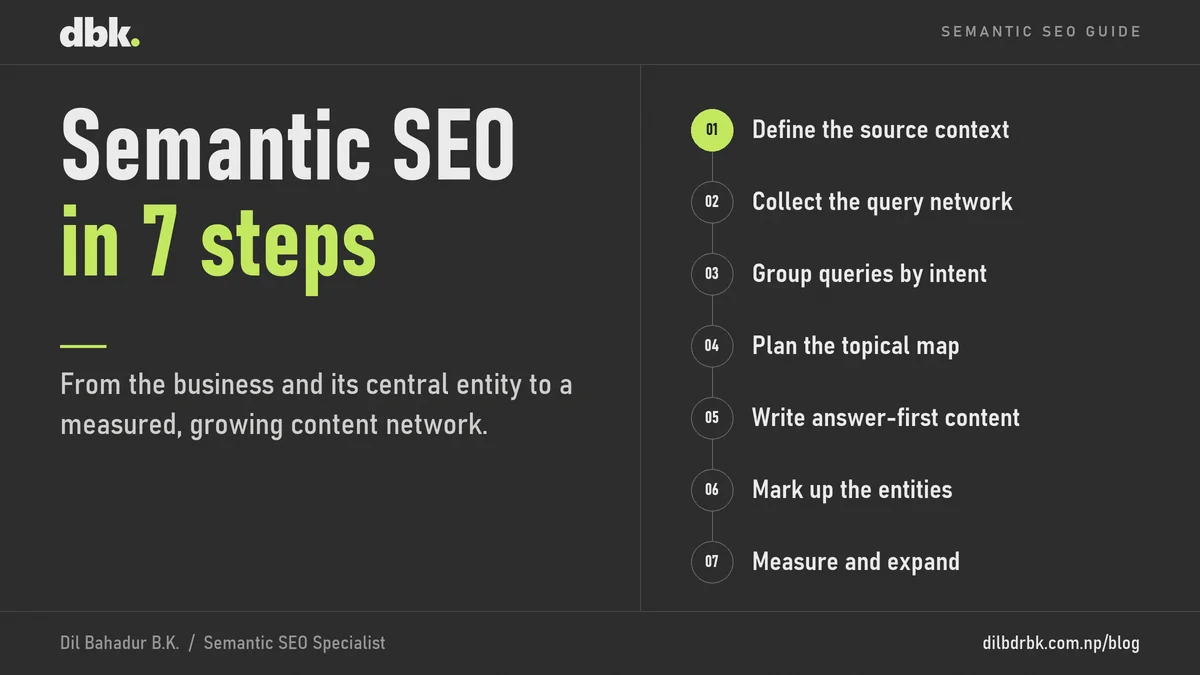
Step 1. Define the source context and central entity. Write down what the business sells, who buys it and which subject the whole site revolves around. A diesel parts store, for example, has turbochargers as one central entity and parts buyers, such as fleets and remanufacturers, as its audience.
The source context filters every later decision. A question that fits the topic but not the business, such as how turbochargers were invented, earns at most a short section, not a page.
Step 2. Collect the query network. Gather the real questions people ask about the central entity. Holistic SEO recommends sources such as Google autocomplete, People Also Ask, related searches, YouTube suggestions, forums and the questions customers ask the business directly.
Collect phrasings as they are, without merging them yet. The way people word a search shows the intent behind it, such as "how much" for cost or "vs" for comparison.
Step 3. Group queries by intent. Sort the queries by what the searcher wants, such as a definition, a comparison, a price or a fix. The 15 intents below come from the same method I use on client topical maps, grouped by the stage of the searcher's journey.
Free tool
Query intent sorter
Paste search queries, one per line. The sorter reads the wording of each query, assigns it to one of 15 intents and groups the intents by the stage of the searcher's journey, with a page type for each group. It is a first pass: a query with no clear cue goes to a review list, never to a guessed group, and every group still needs a human check.
Sorted queries appear here, grouped by journey stage and intent.
The 15 intents and the page type rule come from the topical map method in this guide: understanding, comparison and troubleshooting intents become guides, while cost, selection and buying intents usually belong on service or product pages. Nothing you paste leaves your browser.
Intent groups decide the page type. Questions that want to understand or compare become guides, while questions that want to buy, hire or compare prices usually belong on service or product pages.
Step 4. Plan the topical map and internal links. Turn each intent group into a page or a section, then link the pages from the broad topic down to the specific ones. A question earns its own page when it covers a different entity or task, shows real search demand and has dedicated pages ranking for it.
Internal links carry meaning too. An anchor that names the target page's topic, such as "guide to creating a topical map", tells both readers and search engines what the next page covers.
Step 5. Write answer-first semantic content. Answer each heading in its first sentence, then expand with facts, examples and numbers. Write each fact as a triple, keep the subject near its verb, and follow every plural noun with a concrete instance, such as "brands, such as Garrett and Holset".
Keep the main topic phrase present in every section, so each passage still makes sense when an AI answer lifts it out of the page. Paragraphs of 2 to 4 sentences keep one idea per block.
Step 6. Mark up the entities. Add JSON-LD that names the page's main entity and the entities it mentions, linked to identifiers such as Wikidata items where they exist. Match every fact in the markup to a fact visible on the page.
Use semantic HTML for the layout, and keep the business details, such as name, address and phone, identical across the site and its profiles.
Step 7. Measure and expand. Track rankings across the whole query network in Search Console, not only the head term, and check which searches show the page in AI answers. New queries that appear in the data point to the next sections and pages.
Expand the network where the data shows demand, and update existing pages before adding thin new ones. Holistic SEO warns that opening pages for every small query distorts a topical map and dilutes its ranking signals.
Semantic SEO Example: A Collection Page Rewrite
A semantic SEO rewrite of one e-commerce collection page shows the method on a live site. The page belonged to a US diesel parts store and sold new, rebuilt and used turbochargers.
Before the rewrite, the intro opened with a superlative claim about the reliability of brand-new turbochargers and described the stock as "extensive" and "top-rated". It even said the store sold only new units, while the product grid below listed rebuilt and used ones. A search engine reading it learned only that the store sold turbochargers.
The rewrite applied the core parts of semantic SEO:
- Triples: The opening sentence states what buying a replacement turbocharger does for the engine, with positive predicates that name the gain, and it lists the outcomes a buyer wants back, such as lost power and fuel economy.
- Values: Unmeasured words gave way to ranges from the store's own listings, such as the price range, the share of listings under $1,000 and the engine sizes the units fit.
- Entities: The intro names the buyers, such as fleets and remanufacturers, the brands, such as Garrett and Holset, and the engine makers, such as Cummins and Volvo.
- Selling points: The hero banner gained 4 facts a buyer checks first, such as stock count and shipping terms.
In my live checks on 18 November 2026, the page ranked #1 on US Google for 3 searches that match its triples, such as "new rebuilt and used turbochargers". Google's AI Overviews also cited it as a source. The turbocharger collection page case study shows the full before and after, with blurred screenshots.
Semantic SEO Checklist
A semantic SEO checklist confirms that a page states its meaning clearly before it goes live. The 10 checks below cover the page, its sentences and its place in the site.
- The page answers one intent, and its H1 names the topic.
- Each heading is answered in its first sentence.
- The main entity and its attributes appear with real values, not vague adjectives.
- Key facts are written as triples, with the subject close to its verb.
- Every plural noun is followed by a concrete instance, such as a named brand or number.
- The main topic phrase appears under every main section.
- Paragraphs hold one idea in 2 to 4 sentences.
- The page links to the broader topic above it and the narrower pages below it, with descriptive anchors.
- JSON-LD names the main entity and matches the visible facts.
- Claims name their source, and figures carry a date.
The checker below tests a draft against the checks that can be measured in text. It uses the same writing rules I apply to every guide on this site and runs entirely in your browser.
Free tool
Semantic content checker
Paste a draft with its headings marked as # H1, ## H2 and ### H3, and enter the main topic phrase. The checker tests the draft against the measurable rules from the checklist above: answer-first headings, the topic phrase under every main section, paragraph length, concrete examples after plural nouns, heading order, dashes and overused filler words. It checks the writing, not the facts, so it is not a Google score.
Results appear here, with the line of each issue.
The filler-word list and the 2 to 4 sentence paragraph rule follow the writing rules every guide on this site passes before publishing. Nothing you paste leaves your browser.
Common Semantic SEO Mistakes
Most semantic SEO mistakes come from treating meaning as a word list. Each of the 6 mistakes below conflicts with a Google statement or with the method in this guide.
- Chasing "LSI keywords": Latent semantic indexing is a 1980s retrieval technique, and Google's John Mueller said in July 2019 that there is no such thing as LSI keywords. Related terms help only when they complete the meaning of the topic.
- Stuffing synonyms: Repeating a phrase in many variants can still amount to keyword stuffing, which Google's spam policies define as filling a page with keywords or numbers to manipulate rankings.
- Writing to a tool score: Content tools that count terms measure word frequency, not whether the page answers the question. Holistic SEO notes that TF-IDF is of limited importance, useful mainly to see how competitors approach a subject.
- Creating a page for every query: Thin pages for small variations split relevance and confuse the topical map. A question that shares the same entity and intent belongs as a section.
- Burying the answer: A page that opens with background makes search engines and readers hunt for the fact. Passage ranking judges sections on their own, so a section that answers first is easier to match.
- Marking up facts the page does not show: Google's structured data guidelines state that markup must not describe content that is not visible to readers of the page.
Each mistake has the same fix: state the facts plainly, once, in the section where the reader expects them.
Semantic SEO for AI Search
Semantic SEO prepares a site for AI search because AI features compose answers from web pages and link to them as sources. Google states that AI Overviews and AI Mode surface relevant links to help people find information quickly and reliably.
Google states that AI Overviews and AI Mode may use a "query fan-out" technique, which issues multiple related searches across subtopics and data sources to build one response. Google also states that there are no additional requirements or special optimizations needed to appear in these features, and that SEO best practices remain relevant. A semantic SEO topical map already covers those subtopics, so fan-out searches are more likely to find a section of the site that answers them.
Three semantic SEO habits carry over directly. Answer-first sections give an AI system a passage that stands on its own, and triples give it a fact it can restate without losing meaning. Consistent entity facts across the web make the source easier to trust.
The guide to getting cited by ChatGPT covers the AI search side in detail, from crawler access to fan-out questions. The Google Knowledge Graph guide explains how entity facts reach Google's database.
Semantic SEO FAQ
Is semantic SEO still relevant in 2026?
Yes, semantic SEO remains relevant in 2026. Google's ranking systems guide, updated in December 2025, still lists language systems such as BERT and neural matching among its current systems. Google's AI features also link to the web pages they draw on.
Does semantic SEO replace keyword research?
No, semantic SEO extends keyword research rather than replacing it. Keywords still show the words people search with, and semantic SEO groups them by meaning and intent, so each group gets the right page.
How long does semantic SEO take to show results?
Semantic SEO has no fixed timeline, and Google publishes none. Results depend on how often Google recrawls the pages, the competition and how much of the topic the site already covers. In the case study above, the rewritten page ranked #1 for 3 searches within about 3 months of the change.
Are LSI keywords part of semantic SEO?
No, LSI keywords are not part of semantic SEO, because Google's John Mueller has said that LSI keywords do not exist. Semantic SEO uses related concepts that complete the meaning of a topic, which is a different idea from adding a list of similar phrases.
Who created the semantic SEO method used here?
The semantic SEO method in this guide draws on Koray Tugberk Gubur's Topical Authority methodology from Holistic SEO, which I learned and apply on client projects. Google's own documentation supports the parts it describes, such as structured data and its language systems.
Can a small website do semantic SEO?
Yes, a small website can do semantic SEO, because the method scales with the number of topics, not the size of the site. A small site applies it to one central entity and the questions its buyers ask, then adds pages only where query data shows demand.
Get a Semantic SEO Plan for Your Site
A semantic SEO plan maps your central entity, the questions your buyers ask and the pages that should answer them, then rewrites key pages so each one states its facts clearly. I build these plans as a semantic SEO consultant for e-commerce stores, local service businesses and B2B companies.
The plan starts with your source context and ends with a topical map, page briefs and the internal links that connect them.
References
Google documentation and statements:
- Google Search Central, A guide to Google Search ranking systems, updated 10 December 2025
- Google Search Central, Introduction to structured data markup in Google Search, updated 10 December 2025
- Google Search Central, Spam policies for Google web search, updated 28 August 2026
- Google Search Central, AI features and your website, updated 10 December 2025
- Google Search Central, General structured data guidelines, updated 10 July 2026
- Pandu Nayak, Google, Understanding searches better than ever before, 25 October 2019
- Amit Singhal, Google, Introducing the Knowledge Graph: things, not strings, 16 May 2012
News coverage:
- Barry Schwartz, Search Engine Roundtable, Google: There Is No Such Thing As LSI Keywords, 31 July 2019
Practitioner sources:
- Koray Tugberk Gubur, Holistic SEO, What is Semantic SEO? How to Use Semantic SEO for Better Rankings
- Koray Tugberk Gubur, Holistic SEO, Semantic Search for Semantic SEO: Understanding the Verbs of Life
- Koray Tugberk Gubur, Holistic SEO, Importance of Lexical Semantics and Semantic Similarity for SEO