
Entity SEO guide
What Is Entity SEO? A Practical Guide
Entity SEO helps search engines identify the people, places, products and concepts on your site. Learn how it works and how to do it in 6 steps.

Short answer
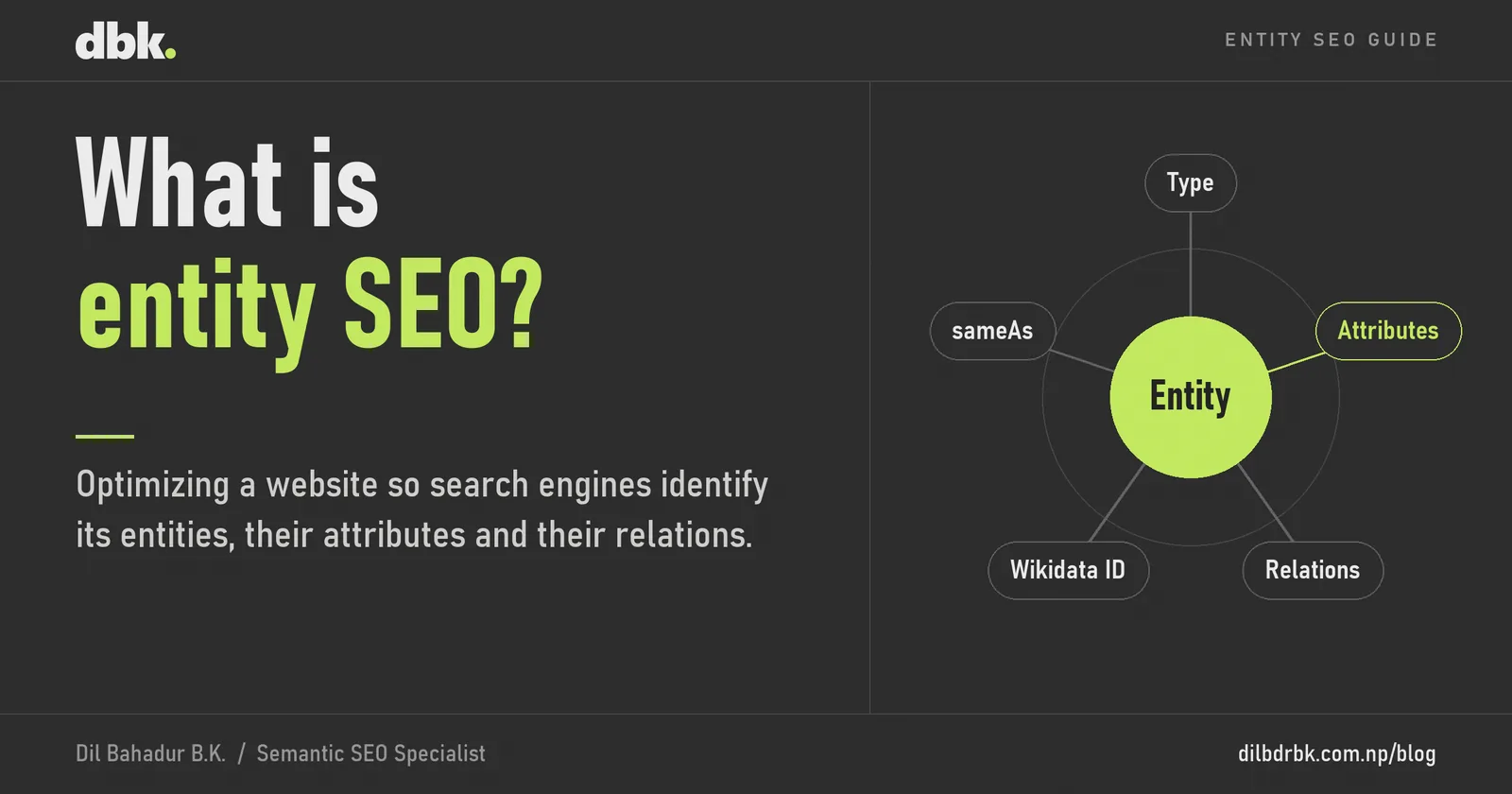
Entity SEO is the practice of optimizing a website so search engines identify the entities on it, understand their attributes and relations, and connect the website to those entities. An entity is a single, identifiable thing, such as a person, a place, an organization, a product or a concept like the color blue.
Google announced the Knowledge Graph on 16 May 2012 under the title "things, not strings". The announcement marked a shift from matching keywords to understanding real-world things and the facts that connect them, such as the population of a city or the founder of a company. According to a 2010 Yahoo! study by Pound, Mika and Zaragoza, 40.60% of real web queries were entity queries, and over 70% contained an entity, a type, an attribute or a relation.
This guide covers entity SEO in 9 parts: the meaning of an entity, how search engines read entities, the difference from keyword SEO and semantic SEO, the core concepts, a 6-step method, recognition checks, examples by business type, the role of entities in AI search, and entity SEO services. Each part answers a question that people search for, such as "how to do entity SEO" or "entity SEO vs semantic SEO".
In this guide
What Is an Entity in Entity SEO?
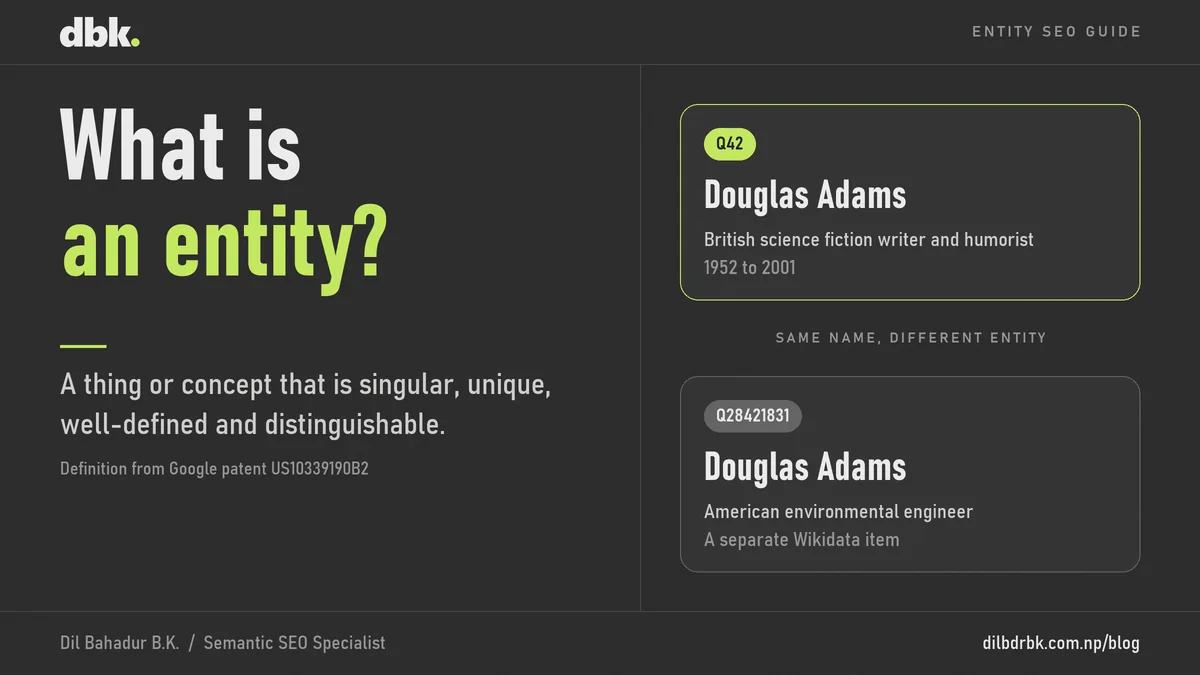
According to Google patent US10339190B2, an entity is "a thing or concept that is singular, unique, well-defined and distinguishable". A related Google patent, US11928168B2, separates an entity from an entity reference, which is the text string that names the entity, such as "New York City". Entity SEO optimizes for the entity itself, not only for the strings that point to it.
Business websites mention 5 common entity types:
- People, such as Douglas Adams or the founder of a company
- Places, such as Kathmandu or the service area of a plumber
- Organizations, such as Google or a local dental clinic
- Products, such as a running shoe model with its own GTIN
- Concepts, such as entity SEO or the color blue
Every entity has a record and an ID in a knowledge base. Wikidata stores Douglas Adams, the British science fiction writer, under the ID Q42, and an American environmental engineer with the same name under Q28421831. The ID keeps two people with one name apart, and it connects every mention of the same person across languages and websites.
According to the 2025 annual report of Wikimedia Deutschland, Wikidata holds over 120 million items, worked on by over 24,000 volunteers. These items give websites and knowledge bases a shared set of IDs, such as Q42, for the same things.
Entity vs Keyword
A keyword is a string of characters that a person types into a search box. Search Engine Journal describes an entity as a database record with its own ID. Many strings point to one entity record, such as "NYC", "New York City" and "the Big Apple" for one city.
Google's 2012 announcement used the query [taj mahal] to show the gap between strings and things. According to that announcement, the query can mean a monument, a Grammy Award-winning musician, a casino in Atlantic City or, depending on context, the nearest Indian restaurant.
Google's Search Quality Rater Guidelines give a second example. According to the September 2025 guidelines, the query [ada] has three common interpretations: the Americans with Disabilities Act, the American Dental Association and the American Diabetes Association. The guidelines rate none of the three official homepages as Fully Meets, because no interpretation dominates. Entity SEO removes this doubt on a page by naming the entity clearly and stating the attributes that set it apart.
Attributes, Values and Relationships
Search engines store facts about an entity as triples. Each triple joins an entity, an attribute and a value, such as Nepal, capital and Kathmandu. Holistic SEO calls this structure the entity-attribute-value (EAV) model.
| Entity | Attribute | Value |
|---|---|---|
| Nepal | Capital | Kathmandu |
| Nepal | Highest point | Mount Everest |
| Nepal | Currency | Nepalese rupee |
A relationship links two entities, such as Kathmandu and Nepal through the attribute "capital". According to Holistic SEO, the attributes on a page define its context more than the entity name does. A page about the Nepalese rupee and a page about Mount Everest share the entity Nepal, but they serve different searches.
Free tool
Entity triple builder
Add facts about one entity. Each fact becomes a triple (entity, attribute, value), a plain sentence and a branch of the graph.
The currency of Nepal is Nepalese rupee.
- NepalcapitalKathmandu
- Nepalhighest pointMount Everest
- NepalcurrencyNepalese rupee
How Search Engines Understand Entities in Entity SEO
Search engines process entities in 5 stages, and entity SEO supports each stage:
- Recognize: find names in a text, such as "Kathmandu" or "Google"
- Link: map each name to one record in a knowledge base
- Attach facts: read the attributes and relations of the entity
- Rank: compare pages on relevance, quality and trust
- Answer: show a link, a knowledge panel or an AI summary
The How Search Works guide on this website shows these stages as a diagram. The sections below explain the knowledge base behind the stages, the recognition step, salience and the role of entities in answers.
The Knowledge Graph
Google's Knowledge Graph is a knowledge base of entities and the facts that connect them. According to Google, the graph held more than 500 million objects and more than 3.5 billion facts at its launch in May 2012, rooted in public sources such as Freebase, Wikipedia and the CIA World Factbook. By December 2012, Google reported 570 million entities and 18 billion facts, as listed in the 2014 Knowledge Vault paper by Dong and colleagues at Google.
Google reported in 2020 that the graph held over 500 billion facts about five billion entities. According to a 2023 Dagstuhl manifesto on knowledge representation, Microsoft's Bing graph held over one billion entities and more than 21 billion facts in 2015.
The Knowledge Graph in numbers
- 500M+ objects, 3.5B+ factsGoogle launches the Knowledge Graph from public sources such as Freebase and Wikipedia.
- 570M entities, 18B factsThe size Google reported seven months after launch.
- 1.6B candidate factsKnowledge Vault research extracts facts from web pages.
- 3B+ facts, almost 50M entitiesFreebase turns read-only, and its data moves to Wikidata.
- 500B facts, 5B entitiesThe latest size Google has published.
Web pages feed these graphs with facts. Google's Knowledge Vault research extracted about 1.6 billion candidate facts from the web, and about one third of its 271 million confident facts were new to Freebase. The same paper found that 71% of people in Freebase had no known place of birth in October 2013, which shows how many facts a curated knowledge base can miss.
Knowledge panels show these facts in search results. In its 2019 white paper How Google Fights Disinformation, Google describes knowledge panels as elements that give context and basic information about people, places or things that Google knows about. In a 2014 Google eye-tracking study by Lagun and colleagues, mean satisfaction rose from 5.28 to 5.69 on a 7-point scale when a Knowledge Graph panel appeared.
Entity Recognition and Entity Linking
Named entity recognition finds the names of people, places and organizations in a text, such as "Mercury" in a sentence about planets. Holistic SEO defines entity linking as mapping each name to one record in a knowledge base, so "Mercury" in that sentence points to the planet and not to the chemical element. Google holds patents on models that predict which entity a text refers to, such as US9251141B1, although a patent shows a method and does not prove that Search uses it.
Entities fill most search queries. The Yahoo! study by Pound, Mika and Zaragoza labeled 40.60% of sampled queries as entity queries and 12.13% as type queries. A 2012 Microsoft Research study by Lin and colleagues examined 200 query-click pairs and found an entity in 43% of queries and an entity category in another 14%.
How many searches are about entities?
Yahoo! web queries, 2010
- Entity40.6%
- Type12.1%
- Attribute4.6%
- Relation0.7%
- Other keywords36.1%
- Uninterpretable5.9%
Microsoft query sample, 2012
- Entity29%
- Entity + refiner14%
- Category4%
- Category + refiner10%
- Website28%
- No entity15%
A 2009 study reported named entities in 71% of queries, but Lin and colleagues note that it does not state whether repeated queries were counted. Entity SEO answers this demand by matching each page to one main entity and its attributes.
Entity Salience
Salience measures how central an entity is to a text. According to the Google Cloud Natural Language API documentation, salience scores run from 0 to 1.0, and scores close to 1.0 mark highly salient entities.
A 2014 study by Dunietz and Gillick of Carnegie Mellon University and Google examined 110,639 New York Times articles and found that only about 14% of mentioned entities were salient. A rule that marked entities in the first sentence as salient reached an F1 score of 46.2, and a model that also counted repeated mentions reached 61.6. Entity SEO applies the finding in 2 ways: the main entity appears in the title, the H1 and the first sentence, and the page keeps naming it in later paragraphs.
Entities in Answers and AI Results
Google patent US11928168B2 describes a system that answers "who" questions by choosing the entity reference that appears most often in the top search results. Answers built this way depend on pages that name entities clearly.
Google's 2015 Knowledge-Based Trust research, led by Xin Luna Dong, scored 119 million webpages by the correctness of their facts. The score barely tracked PageRank: 14 of 15 known gossip websites ranked in the top 15% by PageRank but in the bottom 50% by factual trust. Google has not confirmed this method as a ranking factor, so entity SEO treats it as research context and not as a rule.
Entity SEO vs Keyword SEO vs Semantic SEO
Entity SEO, keyword SEO and semantic SEO overlap, but each approach optimizes a different unit. The table compares the 3 approaches on 5 points.
| Point | Keyword SEO | Entity SEO | Semantic SEO |
|---|---|---|---|
| Unit of optimization | A query string, such as "dentist kathmandu" | A thing with an ID, such as a dental clinic | A topic and its network of meanings |
| Relevance signal | Matching words and close variants | Clear entities, attributes and relations | Coverage, context and links between pages |
| Planning tool | Keyword list | Entity and attribute map | Topical map |
| Typical output | One page per keyword group | Pages and markup that define entities | A connected set of pages around a topic |
| The query [ada] | One string to match | Three separate entities to tell apart | Context that shows which meaning a page serves |
Holistic SEO treats entities as one layer of semantic SEO, next to context, topical maps and query networks. Ahrefs argues that entity SEO is simply good SEO. Both views lead to the same practice: name entities clearly, state their facts and connect related pages. The guide to entity SEO vs keyword SEO compares the first 2 approaches in depth, with Google's documentation and research on both.
Core Concepts Behind Entity SEO
Entity SEO rests on 5 concepts from semantic SEO, most of them defined by Koray Tugberk Gubur of Holistic SEO. The concepts decide which entity a website centers on, which attributes it covers and how its pages connect.
Central Entity and Source Context
The central entity is the main entity that a website covers, such as books for a bookstore or dental care for a clinic. According to Holistic SEO, source context is the purpose of the website and the way it earns, such as selling books online.
Holistic SEO uses a book e-commerce website as its example of source context. A bookstore covers the attributes that help a buyer choose, such as author, genre, format and price, because its source context is selling books.
Attribute Prominence, Relatedness and Popularity
Holistic SEO ranks the attributes of an entity by prominence, relatedness and popularity. Prominence measures how much an attribute defines the entity, relatedness measures how close it sits to the source context, and popularity measures how often people search for it. For a dental clinic, the attribute "treatment price" scores high on all 3 measures, while "year founded" scores low on popularity.
Topical Map and Contextual Bridges
In Holistic SEO terms, a topical map is a plan of the topics, subtopics and query networks that a website covers for its central entity. The map grows in 3 directions: more entities, more attributes or deeper context. A contextual bridge is a passage or link that connects two related topics, such as a link from a page about teeth whitening to a page about whitening costs.
Entity Authority and Topical Authority
Topical authority describes how much a search engine trusts a source on a topic. In a case study published on Oncrawl, Koray Tugberk Gubur frames topical authority as topical coverage multiplied by historical data.
Entity authority adds the real-world side. Google's rater guidelines apply reputation research to both the website and the actual company, organization or entity behind it, and they call Trust the most important member of the E-E-A-T family. Entity SEO supports trust by keeping the facts about an entity consistent on every page and profile.
Cost of Retrieval
Holistic SEO defines cost of retrieval as the effort a search engine spends to crawl, process and rank content. Duplicate pages and unneeded URLs, such as filter combinations and thin tag pages, raise that cost. Entity SEO lowers it by giving each entity and attribute one clear page or section.
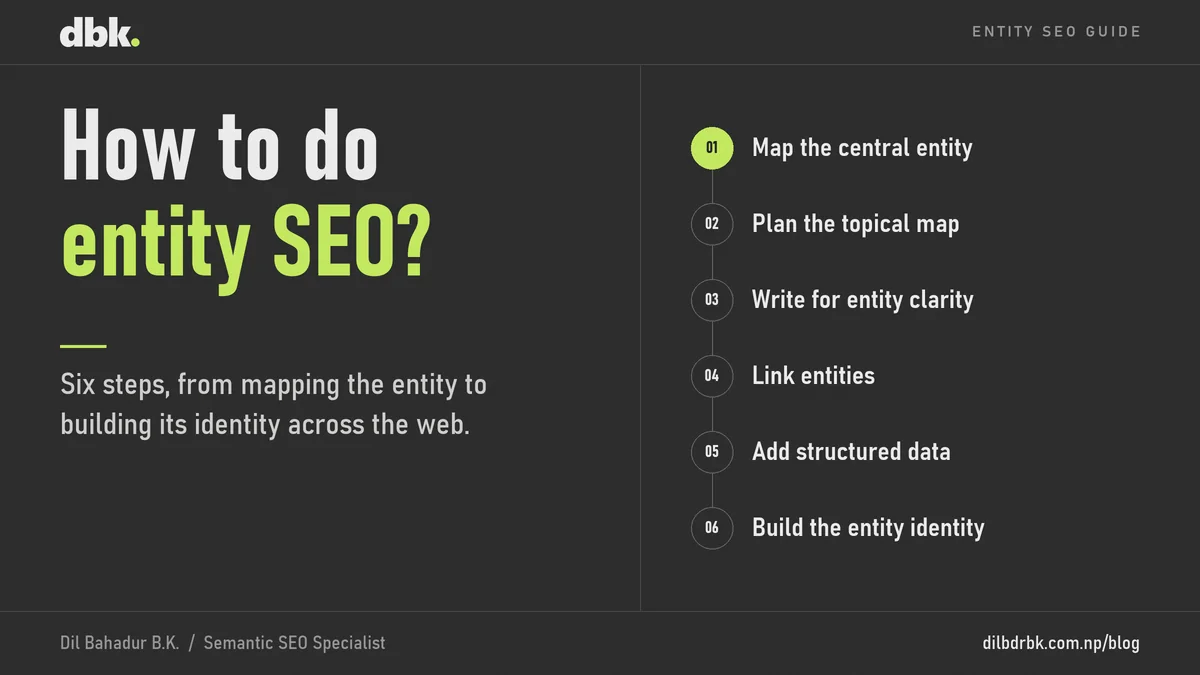
How to Do Entity SEO in 6 Steps
Entity SEO follows 6 steps, from mapping the entity to building its identity across the web. Each step below names the action, the method, an example and one mistake to avoid.
Step 1. Map the Central Entity and Its Attributes
Entity mapping lists the central entity, its type, its attributes and its related entities in one sheet. The sheet holds 6 columns: entity, type, attribute, value, source and ID, such as a Wikidata Q-ID when one exists.
A dental clinic in Kathmandu maps its services, dentists, location, opening hours and prices as attributes. The mistake to avoid is mapping keyword variants, such as "dentist near me" and "dentist nearby", as separate attributes.
Step 2. Plan a Topical Map From the Attributes
A topical map turns the attribute list into pages and sections. Following the Holistic SEO method, each core attribute gets a page or a section in order of prominence, relatedness and popularity, and contextual bridges connect the pages.
The dental clinic gives each treatment, such as root canal treatment and braces, its own page, and it covers opening hours in a section of the contact page. The mistake to avoid is one page per keyword variant, which raises the cost of retrieval.
Step 3. Optimize Content for Entity Clarity
Entity optimization makes each entity easy to recognize on a page. As Search Engine Journal recommends, the page uses one consistent name per entity, places the main entity early and names co-entities that remove doubt, such as "NASA" and "the Sun" next to "Mercury" the planet.
Facts belong in plain sentences, lists and tables, because even large knowledge bases miss many facts, as the Freebase gap above shows. The mistake to avoid is hiding core facts, such as prices or service areas, in images or vague marketing copy.
Step 4. Link Entities Inside the Site and to Trusted References
Entity linking connects each entity mention to its best page on the site and, where it removes doubt, to one trusted reference outside it, such as an official website or a Wikidata item. The anchor text names the entity, such as "root canal treatment" instead of "click here".
Internal links to the entity home, such as the About page of a person or the homepage of a company, help search engines identify the URL that represents the entity. The mistake to avoid is generic anchors, which carry no entity meaning.
Step 5. Mark Up Entities With Structured Data
Structured data describes an entity in a format that machines read directly. Google Search Central recommends JSON-LD and documents Organization markup for details such as a logo, an address and contact points. The schema.org property sameAs connects an entity to its profiles, such as Wikidata, LinkedIn and GitHub.
Most websites leave part of this gap open. According to HTTP Archive's Web Almanac 2025, JSON-LD appears on 43% of home pages, but Organization markup appears on 26.2% and Person markup on 5.9% of mobile home pages.
Which entity types do home pages mark up?
Wikidata links are rarer still. According to the Web Almanac 2024, only 0.2% of mobile pages used sameAs to link to wikidata.org, against 4.5% for facebook.com. Markup also grew more detailed. A University of Mannheim study by Brinkmann, Primpeli and Bizer found that the average JSON-LD page carried 52 RDF quads, or machine-readable statements, in 2022, up from 10 in 2015.
Markup must match the visible page. A 2021 study by Alrashed and colleagues at MIT and Google found that pages from 61% of hosts with Dataset markup did not describe datasets, and Google filters these pages with a classifier. In Google's Knowledge Vault research, only 0.25 million of 140 million facts read from markup alone reached high confidence. The mistake to avoid is markup that claims facts the page does not show.
Free tool
Entity schema generator
Describe the entity behind a website and copy the JSON-LD for its entity home. The example shows the Person markup of this site.
<script type="application/ld+json">
{
  "@context": "https://schema.org",
  "@type": "Person",
  "@id": "https://dilbdrbk.com.np/#person",
  "name": "Dil Bahadur B.K.",
  "url": "https://dilbdrbk.com.np/",
  "jobTitle": "Semantic SEO Specialist",
  "image": "https://dilbdrbk.com.np/assets/img/dil-bahadur-bk.jpg",
  "description": "Semantic SEO specialist in Kathmandu, Nepal.",
  "sameAs": [
    "https://www.linkedin.com/in/dil-bahadur-b-k-3927642ab/",
    "https://github.com/Dilbdrbk"
  ]
}
</script>
Paste the code into the head of the entity home, such as the homepage or the About page, then test the page in the Rich Results Test.
Step 6. Build a Consistent Entity Identity Across the Web
Entity building repeats the same core facts about an entity on trusted sources, such as business profiles, directories and Wikidata. According to Google, knowledge panels are generated automatically, and the subject of a panel can claim it after verification.
The source of a fact decides whether a knowledge base accepts it. A 2016 paper by Pellissier Tanon and colleagues at Google and Wikimedia describes this case: Google offered machine-extracted facts to Wikidata, and the facts were usually accurate. Many source pages still failed the reliability rules of Wikidata, such as pages from social network sites and reviews on shopping sites.
Knowledge panels often carry Wikipedia links. According to a 2019 Northwestern University study by Vincent and colleagues, Wikipedia appeared on 58% of Google results pages, and on 69% when Knowledge Panel links were counted. The mistake to avoid is inconsistent facts, such as two different founding years on two profiles.
An entity map and a topical map turn these 6 steps into a page plan for one website.
How to Check Whether Google Recognizes Your Entity
Entity SEO needs a baseline before the work starts and a comparison after it ends. Six free checks show whether Google and Wikidata recognize an entity:
- Knowledge Graph Search API: a lookup returns the ID, type, description and result score of an entity
- Knowledge panel: a search for the brand or person name shows whether a panel appears and which facts it shows
- Natural Language API demo: a sample text returns the entities that Google's model recognizes and their salience scores
- Rich Results Test and Schema Markup Validator: both tools read the structured data on a page and report errors
- Wikidata search: a search shows whether the entity has a Q-ID and which facts the item holds
- Search Console: the Performance report shows the queries that contain the brand name and the entity names
Free tool
Entity recognition checker
Enter an entity name and the URL of its entity home. Each link opens one of the free checks in a new tab, filled in where the tool allows it.
- Knowledge panel searchDoes a panel appear for the name, and which facts does it show?
- Wikidata searchDoes the entity have a Q-ID, and which facts does the item hold?
- Knowledge Graph Search APINeeds a free API key; returns the ID, type, description and result score.
- Natural Language API demoPaste a paragraph from the page to see its entities and salience scores.
- Rich Results TestReads the structured data on the entity home and lists errors.
- Schema Markup ValidatorShows every schema.org type and property on the page.
- Search ConsoleFilter the Performance report by the brand name to see entity queries.
Repeating the same 6 checks every quarter shows whether entity SEO work changes recognition over time.
Entity SEO Examples by Business Type
Entity SEO looks different for each business model. Three examples show the entity, its attributes and its markup for a local service business, an e-commerce store and a personal brand.
Local service business. A plumbing company is an organization entity with attributes such as services, service areas and opening hours. The company keeps these facts identical on its website and its Google Business Profile, and it marks up its homepage with LocalBusiness markup. According to the Web Data Commons study, websites with LocalBusiness markup grew from 386,000 to 1.2 million in the five years to 2022. The Web Almanac 2025 still found the markup on only 5.0% of mobile home pages.
E-commerce store. An online store sells product entities, each with a brand, a model and identifiers such as a GTIN or an MPN. Product markup carries these identifiers, but few websites fill them. According to the Web Data Commons study, 98.67% of websites that mark up products include the product name, while 4.06% include gtin13 and 8.59% include mpn. Category pages group the products by attributes, such as size or material.
Personal brand. A consultant is a person entity with attributes such as a job title, skills and credentials. This website, dilbdrbk.com.np, uses its About page as the entity home, and its Person markup lists 11 sameAs profiles, such as LinkedIn and GitHub, under one consistent name. According to the Web Almanac 2025, Person markup appears on 5.9% of mobile home pages.
Why Entity SEO Matters for AI Search
AI search reads entities before it writes an answer. Google Search Central states that AI Overviews and AI Mode may use a "query fan-out" technique, issuing multiple related searches across subtopics and data sources to develop a response. Each related search gives an entity-clear page another chance to appear as a supporting link.
Entity SEO affects AI answers in 3 ways:
- Models learn frequent entities better. In a 2023 study by Kandpal and colleagues, BLOOM-176B answered questions with 25% accuracy when about 10 training documents contained both the question entity and the answer entity, and with above 55% accuracy at about 10,000 documents.
- Knowledge graphs ground answers. Google's 2024 DataGemma research raised the factual accuracy of a model's statistics from a range of 5% to 17% to about 58% by grounding the model in Data Commons, a knowledge graph built with Schema.org.
- Entity hubs now serve AI builders. According to its 2025 annual report, Wikimedia Deutschland released a Wikidata vector database for AI developers in autumn 2025, with about 23 million items in its first phase and 100,000 to 150,000 accesses a month.
Consistent entity facts give AI systems the same answer from every source they read. The GEO and AEO section of the Expertise page shows how this website approaches AI search.
Entity SEO Services: Get an Entity Map for Your Site
Entity SEO services turn the method above into a plan for one website. I deliver 4 outputs in an entity SEO project:
- Entity and attribute map: the central entity, its attributes, its related entities and their IDs
- Topical map: a page-or-section decision for every core attribute
- Structured data plan: Organization, Person, LocalBusiness or Product markup with sameAs links
- Entity identity audit: a check of the facts on the website, its profiles and knowledge bases such as Wikidata
The service fits local service businesses, e-commerce stores and B2B companies, such as the 25+ industries on the Industries page.