
Entity SEO guide
Entity SEO vs Keyword SEO: What Changes and What Stays
Entity SEO vs keyword SEO: keywords show how people search, entities show what they mean. See the differences, where each works and how to combine them.

Short answer
Keyword SEO optimizes a page for the words people type into a search box, and entity SEO optimizes it for the things those words refer to, such as people, places, products and concepts. Keyword SEO decides which questions a page answers. Entity SEO makes sure search engines understand the answer, so a current SEO strategy uses both.
Google introduced its Knowledge Graph on 16 May 2012 under the title "things, not strings", and the phrase became the short summary of entity SEO. The shift did not retire keywords. Google's How Search Works guide still names content that contains the same keywords as a search as the most basic signal of relevance.
This guide compares keyword SEO and entity SEO from the core difference and the way each approach works to site architecture, search features, AI Overviews, a 7-step combined workflow, a worked example, common mistakes and measurement. Google's documentation, information retrieval research and Google's AI search guidance point the same way: keywords show what people ask, entities show what a page means, and current search systems read both. Each part separates what Google documents from what research shows and from what SEO practitioners interpret.
In this guide
What Is the Difference Between Entity SEO and Keyword SEO?
Entity SEO and keyword SEO optimize different units. Keyword SEO works with search strings, the exact words people type, and entity SEO works with the real-world things behind those strings, such as a city, a medical treatment or a phone model.
The table compares the 2 approaches on 10 points.
| Point | Keyword SEO | Entity SEO |
|---|---|---|
| Unit of optimization | A search string, such as "jaguar top speed" | A thing with an ID, such as the jaguar, Wikidata Q35694 |
| Identifier | None: the string itself | A knowledge base ID, such as a Wikidata Q-ID or a Knowledge Graph ID |
| Question it answers | Which words do people search with? | Which thing do those words mean? |
| Research input | Search volume, autocomplete, People Also Ask and Search Console queries | Knowledge bases, entity attributes and related entities |
| Relevance signal | The page contains the words of the search | The page names the entity and states its facts |
| Page planning | One page per keyword group | One page per entity or attribute that earns a page |
| Internal links | Descriptive anchor text that matches the target topic | Links that follow entity relations, such as a model to its brand |
| Structured data | Optional | Describes the entity, with sameAs links to its other profiles |
| Typical failure | Keyword stuffing and near-duplicate variant pages | Ambiguous names and markup that differs from the page |
| Measurement | Impressions, clicks and positions per query | Knowledge Graph entry, knowledge panel and AI answer mentions |
Both columns describe the same page from 2 sides. A page about root canal costs needs the words people search with, such as "root canal cost" and "price of a root canal", and the facts that define the entity, such as the procedure, the usual price range and the factors that change the price.
Real search logs mix both kinds of query. In a 2010 Yahoo! study by Pound, Mika and Zaragoza, 40.60% of sampled web queries sought a specific entity, 12.13% sought a type of entity, and 36.10% were plain keyword queries with no entity, type, attribute or relation as their main intent.
What Is Keyword SEO?
Keyword SEO, also called keyword-based SEO, is the practice of finding the words and phrases people search for and optimizing pages to match them. A keyword is a search string with measurable demand, such as "how much does a root canal cost". Keyword SEO uses that demand to choose topics, write titles and headings, and decide which pages to create first.
What Is Entity SEO?
Entity SEO, also called entity-based SEO, optimizes a website so search engines recognize the entities it covers, read their attributes and relations, and connect the site to those entities. An entity is one identifiable thing, such as a person, an organization, a product or a concept, and it often has an ID in a knowledge base such as Wikidata. The complete guide to entity SEO on this website covers the definition, the core concepts and a 6-step method.
Keywords Are Strings, Entities Are Things
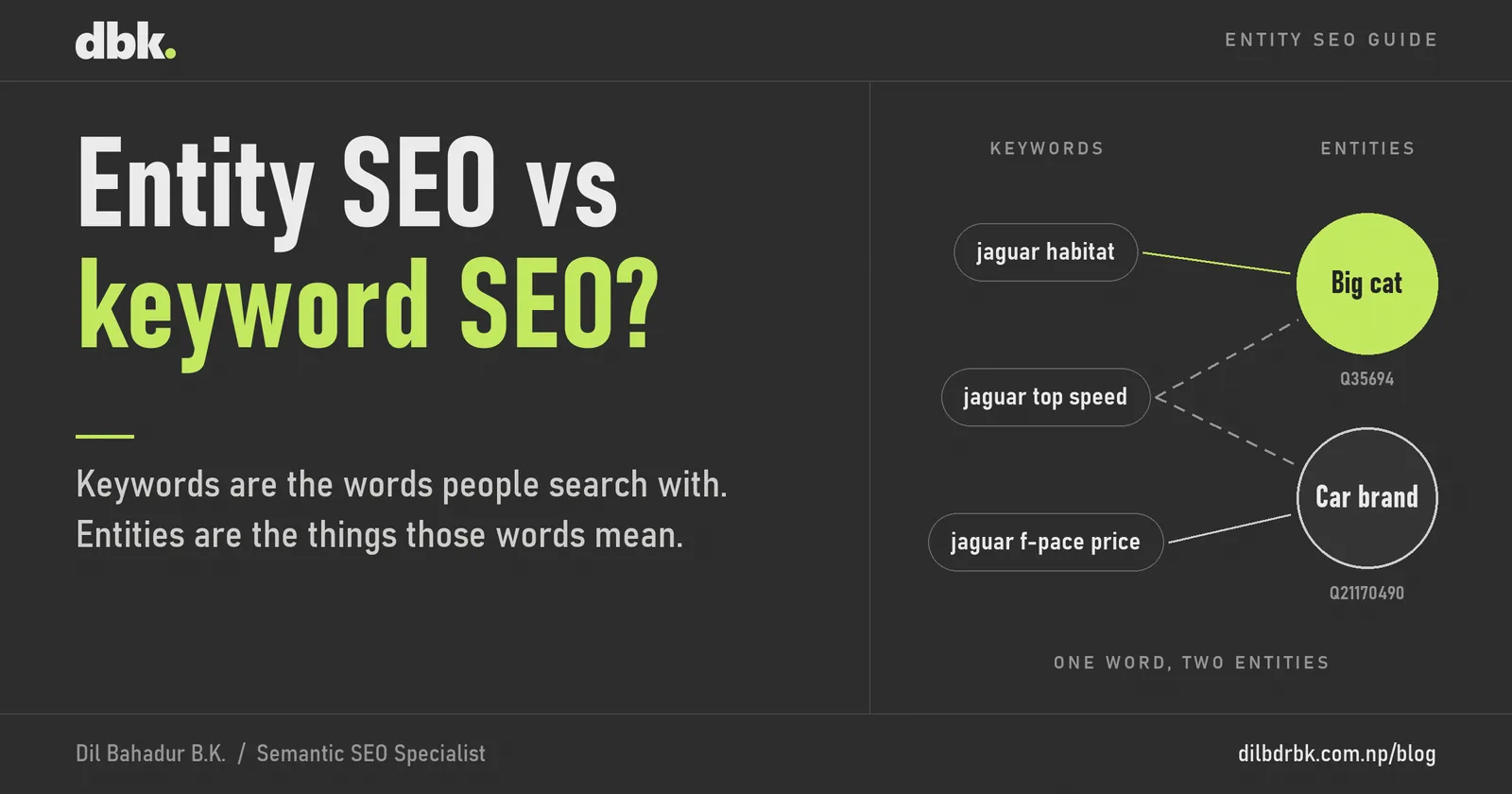
One keyword can point to several entities. The search "jaguar top speed" can refer to the jaguar, a big cat native to the Americas (Wikidata Q35694), or to Jaguar, the British car brand (Wikidata Q21170490). Keyword SEO sees one string, and entity SEO sees 2 things with different facts.
Google's Search Quality Rater Guidelines describe the same problem. According to the September 2025 edition, the query [apple] might refer to the computer brand or the fruit, and raters sort such meanings into dominant, common and minor interpretations, where the dominant interpretation is what most users mean.
Many strings can also point to one entity. The searches "mount everest height", "how tall is everest" and "sagarmatha elevation" all ask about one attribute of Mount Everest (Wikidata Q513), which Wikidata lists at 8,848.86 metres, about 29,032 feet. The same Wikidata item carries labels in many languages, such as सगरमाथा in Nepali, while keyword research runs separately for every language and spelling.
How Keyword SEO Works
Keyword SEO works in 3 stages: research the words people use, match each page to the intent behind them, and place the words where readers and search engines expect them. Entity SEO changes none of these stages, because search engines still start from the words of a query.
Keyword Research and Search Intent
Keyword research collects the searches a business should appear for. Common sources include Google Search Console queries, Google autocomplete, People Also Ask boxes and keyword tools such as Google Keyword Planner. Google's SEO Starter Guide gives the same advice in plain terms: think about the words a user might search for to find a piece of content.
Search intent describes what a person wants to get done. Google's Search Quality Rater Guidelines (September 2025) list 4 intent types: Know queries, including Know Simple queries that seek one specific answer; Do queries, which aim to complete an activity; Website queries, which look for a specific site or page; and Visit-in-person queries, which look for a nearby place. The guidelines also state that no single rating can directly change how a page appears in Google Search, so the categories describe how raters judge results.
SEO tools often use a second set of 4 labels. Semrush classifies keyword intent as informational, navigational, commercial and transactional. Both sets show which kind of page satisfies a search, and the keyword research service on this website groups queries by intent before planning any page.
Why Keywords on the Page Still Matter
Search engines still read the exact words on a page. According to Google's How Search Works guide, the most basic signal that information is relevant is content that contains the same keywords as the search, such as keywords in the headings or body text of a page. The same guide adds that Google uses aggregated and anonymized interaction data to judge relevance beyond simple keyword matching, and that a page which repeats a word hundreds of times does not satisfy the searcher.
Information retrieval research reaches the same result. The BEIR benchmark by Thakur and colleagues (2021) tested 10 retrieval systems on 18 datasets: dense neural retrievers scored from 2.8% to 47.7% lower than BM25, a keyword-matching model, on average, and only a model that re-ranked BM25's results beat it, by 11%. The authors note a keyword-matching bias in several datasets, so BM25 is a strong baseline, not a winner.
A 2022 Google Research study by Chen and colleagues fused BM25 with a neural retriever: the hybrid raised recall by 20.4% over the neural model and by 9.54% over BM25 across 3 out-of-domain datasets. The 2 methods find different relevant documents, which supports using both.
Where Keyword SEO Falls Short
Keyword SEO breaks down in 4 common situations, and entity SEO addresses each of them:
- Ambiguous words: one string, such as "jaguar", can mean several entities, and the words alone do not show which one a page covers.
- Synonyms and paraphrases: people describe one need in many ways. Google's How Search Works guide describes a synonym system that matches pages without the exact query words, and it states that the system improves results in over 30% of searches across languages. The SEO Starter Guide adds that Google's language matching systems can relate a page to many queries even when the page does not use their exact terms.
- Variant pages: separate pages for near-identical keywords, such as "dentist near me" and "dentist nearby", compete for the same search and split the links between them.
- Keyword stuffing: Google's spam policies define keyword stuffing as filling a page with keywords or numbers to manipulate rankings, often in a list or out of context.
How Entity SEO Works
Entity SEO works by making each entity on a site easy to recognize, describe and connect. Search engines meet entities in page text, in structured data and in knowledge bases, and entity SEO improves the signals in all 3 places.
Entities, Attributes and Relationships
An entity carries attributes, and each attribute holds a value. The jaguar has attributes such as habitat, diet and conservation status, while Jaguar the car brand has attributes such as parent company, models and country of origin. Relationships connect entities to each other, such as a car model to its brand or a treatment to the clinics that offer it.
Holistic SEO, the framework of Koray Tugberk Gubur, describes this model as entity-attribute-value structure and treats every entity as a topic that gathers its own query networks. The entity triple builder in the entity SEO guide turns facts into triples and shows them as a small graph.
The Knowledge Graph and Entity Recognition
Google stores entity facts in its Knowledge Graph. Google reported more than 500 million objects and more than 3.5 billion facts at the 2012 launch, and over 500 billion facts about five billion entities in 2020, with knowledge panels generated automatically from that graph.
Search engines connect page text to these entities through entity recognition and entity linking. Google's Cloud Natural Language API shows a public version of this step: version 1 of its entity analysis returns each entity it finds, a salience score from 0 to 1.0 for the entity's importance to the text and, where available, a Knowledge Graph ID and a Wikipedia URL. The API is a Cloud product, and Google has not said that Search scores pages with it, so a salience score works as a diagnostic, not as a ranking measure.
Research supports the idea behind salience. In a 2014 study by Dunietz of Carnegie Mellon University and Gillick of Google Research, counts of entity mentions predicted the salient entities of New York Times articles better than raw keyword counts, with F1 scores of 54.1 against 44.4. The entity SEO guide explains recognition and linking in more detail.
Semantic Search Systems Beyond Keyword Matching
Google documents several AI systems that read meaning beyond exact words. Google's guide to its ranking systems describes 4 of them:
- BERT: understands how combinations of words express different meanings and intent.
- Neural matching: understands representations of concepts in queries and pages and matches them to one another.
- RankBrain: understands how words relate to concepts, so Google can return relevant content even when it lacks some of the exact words of a search.
- Passage ranking: identifies individual sections of a page to judge how relevant the page is to a search.
The same guide lists 17 active ranking systems, and none of them names entities or the Knowledge Graph. It also lists Hummingbird, a major improvement to Google's ranking systems in August 2013, among its retired systems. Google documents meaning-based matching, and entity SEO practitioners read it as support for clear, well-connected entity facts, which is an interpretation, not a confirmed mechanism.
Structured Data and Entity Identity
Structured data states entity facts in a format that machines read directly. According to Google Search Central, Google uses structured data to understand the content of a page and to gather information about the web and the world, such as the people, books or companies in the markup. The schema.org property sameAs links an entity to its other profiles, such as a Wikidata item or a LinkedIn page.
Structured data does not raise rankings by itself. A 2020 Google Search Central post states that structured data by itself is not a generic ranking factor, although it helps Google understand a page and can make the page eligible for rich results. Google's general structured data guidelines add that markup must be a true representation of the page content.
Where Entity SEO Falls Short
Entity SEO has 4 common limits, and keyword SEO covers most of them:
- No demand data: a knowledge base lists an entity's attributes, but it does not show how many people search for each one. Keyword data fills that gap.
- No guaranteed Knowledge Graph entry: Google's systems decide which entities and facts enter the Knowledge Graph, and knowledge panels are generated automatically from it. Verified people and organizations can suggest changes to their own panel.
- Harder measurement: Search Console reports clicks and impressions by query, but it has no report for entity recognition, so entity progress needs separate checks.
- Patent overreach: many entity SEO claims rest on Google patents, such as US 10,235,423 B2, "Ranking search results based on entity metrics". Another patent, US 9,336,211 B1, describes mapping an entity back to the search query that retrieves it best. A patent shows a method Google claimed, not a method Google confirms it uses in ranking.
How Keywords, Entities, Attributes and Intent Fit Together
Most searches combine an entity, an attribute and an intent. The search "how much does a root canal cost" names an entity (root canal treatment, Wikidata Q905815), an attribute (cost) and an intent (a Know query, often before a booking). Keyword SEO captures the wording of the search, and entity SEO captures its meaning.
The table breaks 5 searches into their parts.
| Search | Entity | Attribute | Intent |
|---|---|---|---|
| jaguar top speed | The jaguar (Q35694) or Jaguar, the car brand (Q21170490) | Top speed | Know Simple |
| how much does a root canal cost | Root canal treatment (Q905815) | Cost | Know |
| mount everest height | Mount Everest (Q513) | Elevation | Know Simple |
| iphone 17 battery life | iPhone 17 (Q136193312) | Battery life | Know |
| dentist near me open now | Dentist (Q27349), as a type of local business | Location and opening hours | Visit-in-person |
Holistic SEO defines a query network as a collection of query clusters, where each cluster is a collection of related queries, and it uses search volume to choose the seed query of each cluster. Koray Tugberk Gubur sets the priority plainly: the "keyword gap" matters less than the "information gap". The query network entry in this website's glossary gives a short definition.
Free tool
Keyword to entity breakdown
Pick a search. The left side lists the words keyword SEO targets, and the right side lists the entity facts entity SEO makes clear.
Searchjaguar top speed
Keyword SEO: words to use
- jaguar
- top speed
- how fast
- km/h and mph
Entity SEO: facts to make clear
The jaguar, a big cat (Wikidata Q35694), or Jaguar, the car brand (Wikidata Q21170490)
- Which jaguar the page covers, named in the first lines
- The speed with a unit, such as km/h or mph
- The source of the figure
- For the car: the model and year the figure applies to
Intent: Know Simple. The words fit both entities, so the facts decide which one the page answers.
How Entity SEO and Keyword SEO Shape Site Architecture, Topical Authority and Links
Keyword SEO and entity SEO lead to different site structures. Keyword SEO groups pages by search wording, and entity SEO groups pages by the things they describe and the relations between them.
Page Planning: Keyword Groups vs Entity Maps
Keyword SEO plans pages from keyword groups: searches with the same intent and similar wording share one page. Entity SEO plans pages from an entity map: the central entity, its attributes and its related entities, with a decision for each attribute about whether it earns its own page or a section on a parent page.
The 2 methods answer different planning questions. A dental clinic's entity map lists treatments, such as root canal treatment and braces, as attributes, and its keyword data shows which treatments people search for most and in which words. The topical map diagram on this website shows how attributes become pages or sections.
Topical Authority Beyond Keyword Coverage
Topical authority describes a site that covers a topic in depth and connects its pages around that topic. Holistic SEO defines it as a semantic SEO method for ranking higher by covering connected topics and the queries they imply with accurate, unique and expert information. The topical authority entry in the glossary summarizes the concept.
Google's documentation uses the term for one specific system. According to a May 2023 Google Search Central post, Google's topic authority system helps determine which expert sources are helpful for news searches in specialized topic areas, such as health, politics or finance. Google has not described a general topical authority score for all websites, so the wider concept remains an SEO framework.
Internal Links: Keyword Anchors vs Entity Relations
Keyword SEO uses internal links to pass relevance through anchor text, and entity SEO uses them to express relations between entities. Google's link guidance supports both uses. According to Google Search Central, good anchor text is descriptive, reasonably concise and relevant to both the linking page and the target page, and every page that matters should have a link from at least one other page on the site.
The same guidance warns against forcing keywords into anchor text and repeats that keyword stuffing violates Google's spam policies. An entity-based link plan links each entity page to its attributes and related entities, such as a treatment page to the clinic location that offers it, with anchors that name the target entity.
Entity SEO vs Keyword SEO in Rankings and Search Features
Keyword SEO and entity SEO affect the same results page, but each one matters more for certain features. Blue links reward both, and knowledge panels depend on entities alone.
Organic Blue Links
Organic rankings draw on both kinds of signal: Google documents keyword matching as the basic relevance signal and describes BERT, neural matching and RankBrain as systems that read meaning. A page that uses the searcher's words and states the entity's facts clearly suits both kinds of system. The ranking diagram on this website shows the stages from a search to a ranked page.
Featured Snippets and People Also Ask
Featured snippets show a short answer above the organic results. According to Google Search Central, a site cannot mark a page as a featured snippet: Google's systems decide whether a page would make a good one, and site owners can only opt out with settings such as nosnippet. Answer-first paragraphs that repeat the question's words and state the entity's attribute, such as "Mount Everest is 8,848.86 metres (29,032 feet) tall", give those systems a short, complete passage to work with.
People Also Ask boxes show related questions, such as "what is an entity in SEO" and "do keywords still matter for SEO". Many of these questions pair an entity with an attribute or an intent, so they double as keyword research for the next section of a page.
Knowledge Panels and Rich Results as Entity Features
Knowledge panels are entity features: Google generates them automatically from its Knowledge Graph, not from keyword matches. Rich results, such as product prices or recipe ratings, depend on structured data that describes the entity on the page, and Google's guidelines state that markup makes a feature possible without guaranteeing it.
Entity SEO vs Keyword SEO in AI Overviews and AI Search
Keyword SEO and entity SEO both matter in AI Overviews and AI Mode, because Google states that these features rest on its core Search ranking and quality systems and may run several related searches for one answer. The evidence on how entity SEO and keyword SEO affect the links in those answers falls into 3 groups: what Google documents, what industry studies measure and what remains a hypothesis.
What Google Documents
Google has published 6 relevant statements about its AI search features:
- No special optimization: according to Google Search Central, there are no additional requirements to appear in AI Overviews or AI Mode, and no special schema.org markup is needed.
- Eligibility: a page must be indexed and eligible to show in Google Search with a snippet to appear as a supporting link.
- Query fan-out: AI Overviews and AI Mode may issue multiple related searches across subtopics and data sources to develop a response.
- Core ranking systems: Google's July 2026 guide to generative AI features states that these features are rooted in its core Search ranking and quality systems, and Liz Reid, Google's VP of Search, wrote in May 2024 that AI Overviews run on a customized language model integrated with them.
- Synonyms and variations: the same guide says that AI systems understand synonyms and general meanings, so a site does not need every long-tail keyword variation.
- Inclusion setting: the 2026 guide adds that a site must be included in Search generative AI features in Search Console, which is the default setting.
How Query Fan-Out Connects Keywords and Entities
Query fan-out ties AI answers to both approaches. Each fan-out search is a query of its own, often about one attribute of the same entity, such as the cost, the risks or the recovery time of a root canal, so a page that answers those attributes clearly has more chances to appear as a supporting link. The AI answer diagram on this website shows how one question becomes several searches and a few cited sources.
Search Console counts this traffic as well. According to Google Search Central, clicks from AI Overviews and AI Mode appear in the Performance report within the Web search type, together with other Google Search traffic.
What Industry Studies Show
Industry studies show that AI Overviews often cite pages from Google's organic top 10, but the share ranges from about 17% to 76% depending on the study, its date and its method:
| Study | Published | Sample | Result |
|---|---|---|---|
| Ahrefs | July 2025 | 1.9 million citations from 1 million AI Overviews, top 3 citations each | 76.1% of citations came from top-10 pages |
| seoClarity | October 2025 | 362,000 US desktop queries with AI Overviews | 90% of AI Overviews cited at least one top-10 page |
| BrightEdge | February 2026 | A tracked keyword set of undisclosed size | About 17% of citations came from top-10 pages |
| Ahrefs | March 2026 | 4 million AI Overview URLs across 863,000 searches | 37.9% of citations came from the top 10 positions |
The studies agree that top-10 pages are cited often but far from always. Ahrefs links its own drop from 76.1% to 37.9% to the move of AI Overviews to Gemini 3 in January 2026 and to a larger, better-parsed dataset, so the 2 figures are not a like-for-like trend.
Entity Claims That Remain Hypotheses
Several popular claims about AI search lack confirmation from Google. Examples include claims that entity salience decides which page an AI answer cites, that a knowledge panel raises citation rates and that schema markup makes a page more likely to appear in AI answers. Google states that structured data is not required for generative AI search, and none of the 3 claims has public confirmation, so this guide treats them as hypotheses to test.
The GEO and AEO section of the Expertise page describes how this website approaches AI search, and the testing diagram shows how to test one idea at a time.
Does Entity SEO Replace Keyword SEO?
No. Entity SEO changes how a site plans and describes its topics, and keyword SEO still tells the site which topics, questions and words matter to searchers. Google's documentation supports both, and Krisztian Balog's 2018 book Entity-Oriented Search describes entity search as organizing information around entities, their attributes and relationships, with term-based models as a solid starting point.
SEO practitioners agree on the combination but differ on emphasis. Holistic SEO calls keyword search volume a fundamental factor in SEO but ranks the meaning of a query above its volume. Ahrefs argues that entity SEO is simply good SEO, and articles that call keywords dead conflict with Google's own documentation, which still names keyword matching as a relevance signal.
When Keywords Lead and When Entities Add the Most
The 2 approaches carry different weight for different searches:
- Keywords lead for brand and navigational searches, product codes and model numbers, local "service plus place" searches and new terms that no knowledge base lists yet.
- Entity work adds the most for ambiguous names, brands and people, topics with many attributes and answers that depend on precise facts.
- Entity work has limits for things that knowledge bases do not cover, because Wikidata applies notability rules to new items.
How to Combine Entity SEO and Keyword SEO in 7 Steps
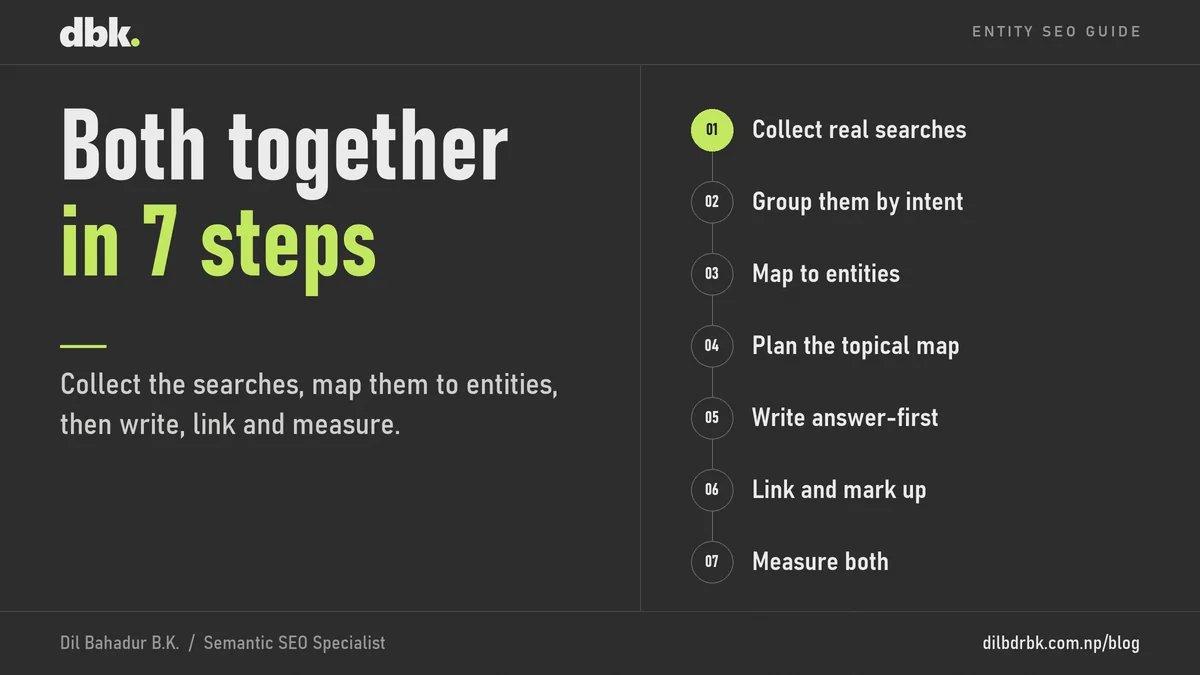
Combine entity SEO and keyword SEO in 7 steps: collect real searches, group them by intent, map each group to an entity and an attribute, plan the topical map, write answer-first, link related entities with matching structured data, and measure both. Each step produces an output that the next step uses.
Step 1. Collect Real Searches
Collect queries from Google Search Console, Google autocomplete, People Also Ask and a keyword tool. Keep the exact wording, such as "does keyword density still matter", because the wording later becomes headings and answers.
Step 2. Group the Searches by Intent
Group the queries by intent and by the type of result Google shows for them, such as guides, product pages or local listings. Searches that show the same type of result can usually share one page.
Step 3. Map Each Group to an Entity and an Attribute
Name the entity and the attribute behind each group, such as root canal treatment and cost. Confirm the entity's ID and its common attributes in a knowledge base such as Wikidata.
Step 4. Plan the Topical Map
Give an attribute its own page when it has its own search demand and a distinct result type, and cover it as a section of a parent page when it does not. The result is a topical map that lists every page with its entity, its attribute and its main search, and the 6-step entity SEO method explains the page-or-section decision in more detail.
Step 5. Write Answer-First With the Searcher's Words
Open each page and section with a direct answer that uses the main words of the search and names the entity. Then add the facts the entity needs, such as prices, measurements, locations or steps. The page anatomy diagram shows the parts of a page that answers one clear question.
Step 6. Link Related Entities and Add Matching Structured Data
Link each page to its parent entity and related entities with descriptive anchors. Add structured data, such as Product, LocalBusiness or Article markup, that describes the same entity as the visible text.
Step 7. Measure Both and Refine
Track keyword results in Search Console and entity results with recognition checks. Update a page when new queries appear in Search Console or when a check shows that Google reads the entity differently from the page.
Worked Example: Keywords and Entities on an Everest Base Camp Trek Page
A trekking agency in Nepal shows how entity SEO and keyword SEO change one page when it follows the 7 steps. Its keyword research collects searches such as "everest base camp trek cost", "ebc trek price" and "everest base camp trek difficulty". Its entity map names the Everest Base Camp Trek (Wikidata Q1950455), Sagarmatha National Park (Q2211959), Lukla (Q389190) and Mount Everest (Q513).
The table compares a keyword-first version of the page with a combined version.
| Element | Keyword-first page | Combined keyword and entity page |
|---|---|---|
| Title | "Everest Base Camp Trek, EBC Trek, Everest Trek Cost" | "Everest Base Camp Trek: Route, Cost, Permits and Best Season" |
| Opening | Repeats "everest base camp trek" 3 times | Answers what the trek is, where it starts and what it costs in one short paragraph |
| Coverage | One page for each keyword variant, such as "ebc trek" and "everest base camp hike" | One page with sections for the route, the cost, the permits, the season and altitude risks |
| Entities named | Only the keyword | The trek, Sagarmatha National Park, Lukla and Mount Everest, each named in full |
| Internal links | Exact-match anchors that repeat the keyword | Links to related pages, such as a Lukla flight guide, with anchors that name each entity |
| Structured data | None | Markup that names the trek and links its entities to Wikidata with sameAs |
| Search wording | Kept | Kept: the searched words still appear in headings and answers |
The combined page keeps every searched word and adds the facts that tell search engines which trek, which park and which starting point the page covers.
Common Mistakes When Moving From Keywords to Entities
Watch for 7 mistakes when a site moves from keyword SEO to entity SEO:
- Dropping keyword research: an entity map without search data plans pages that few people search for.
- One page per keyword variant: near-identical pages for "dentist near me" and "dentist nearby" compete with each other. Google's 2026 guide to generative AI features also warns that separate pages for every fan-out query variation, made primarily to manipulate rankings, violate its scaled content abuse policy.
- Repeating keywords instead of stating facts: a page that repeats "best running shoes" 20 times says less than a page that compares 5 shoes on weight, cushioning and price.
- Vague entity names: a page that says "the product" or "our service" throughout never names the entity that search engines should recognize.
- Markup that differs from the page: Google's structured data guidelines tell site owners not to mark up content that is not visible to readers of the page.
- Treating patents and tools as Google's view: a patent describes a method that Google may or may not use, and a Natural Language API salience score is not a Search ranking score.
- Chasing LSI keywords or keyword density targets: Google's John Mueller wrote in 2019 that LSI keywords do not exist, and Google said in its January 2023 SEO office hours that it has no notion of optimal keyword density.
How to Measure Entity SEO and Keyword SEO
Keyword SEO and entity SEO need different measurements, and a combined strategy tracks both. The table lists 6 measurements and the tool for each.
| What to measure | Tool | What it shows |
|---|---|---|
| Clicks, impressions, CTR and average position per query | Google Search Console Performance report | Keyword visibility, including AI Overviews and AI Mode traffic in the Web search type |
| Positions for priority searches | A rank tracker | Ranking changes for target keywords |
| Whether an entity has a Knowledge Graph entry | Google Knowledge Graph Search API | The entity's ID, type and description, with a result score that shows how well it matched the request |
| How a text's entities are read | Google Cloud Natural Language API, version 1 | Recognized entities and their salience scores, as a diagnostic |
| Whether a knowledge panel appears | A Google search for the entity's name | Panel presence and the facts it shows |
| Mentions and links in AI answers | Manual checks in AI Overviews, AI Mode and AI assistants, such as ChatGPT | Whether the site or brand appears as a source |
Search Console also supports a simple entity check. Filter the Performance report for queries that contain the entity's name and for queries that do not contain the page's main keyword: growth in the second group is a sign that Google matches the page to related meanings, not only to its exact words. Google describes the Knowledge Graph Search API as unsuitable for production-critical use, so it suits spot checks.
Entity checks need repeating on a schedule, such as every quarter. The recognition checks in the entity SEO guide list 6 free tests.
Entity SEO vs Keyword SEO FAQ
Do keywords still matter for SEO in 2026?
Yes. Google's How Search Works guide still names matching keywords as the most basic relevance signal, and Google's SEO Starter Guide tells site owners to think about the words people search for. Keywords also show which questions people ask and how they phrase them.
Is keyword research still important?
Yes, because keyword research is the main source of search demand and real search wording. Entity research shows what a topic contains, and keyword research shows which parts of it people search for.
Does keyword density still matter?
No. Google said in its January 2023 SEO office hours that it has no notion of optimal keyword density and that being explicit matters more than mentioning every variation. Google's spam policies treat filling a page with keywords as keyword stuffing.
Are LSI keywords real?
No. Google's John Mueller wrote in 2019 that there is no such thing as LSI keywords. Related terms still serve readers when they describe the topic, such as the attributes and related entities of the main entity.
Is entity SEO a ranking factor?
No. Google documents no ranking factor called entity SEO, and its ranking systems guide does not mention entities or the Knowledge Graph. Google does document systems that read meaning, such as BERT, neural matching and RankBrain, and entity SEO aims to make a page's meaning clear to systems of that kind.
Does structured data improve rankings?
Not directly. Google states that structured data by itself is not a generic ranking factor, although it helps Google understand a page and can make the page eligible for rich results, such as product details.
Is SEO dead now with AI?
No. Google states that SEO best practices stay relevant because its generative AI features are rooted in its core Search ranking and quality systems. A supporting link in AI Overviews or AI Mode must come from an indexed page that is eligible to show with a snippet.
What is the difference between entity SEO and semantic SEO?
Entity SEO optimizes the things a site covers, and semantic SEO optimizes the meaning of a whole topic, including entities, context and the links between pages. The comparison of keyword, entity and semantic SEO in the entity SEO guide shows all 3 side by side.
Get an Entity and Keyword Map for Your Site
An entity and keyword map turns the entity SEO vs keyword SEO comparison into a plan for one website. I deliver 3 outputs in this kind of project:
- Query research: the searches, their intent and their exact wording, from Search Console and live results
- Entity and attribute map: the central entity, its attributes and its related entities, with their IDs
- Topical map: a page-or-section decision for every attribute, with the main search for each page
The work fits local service businesses, e-commerce stores and B2B companies, such as the 25+ industries on the Industries page.
References
Google documentation and statements:
- Google, How Search Works: Ranking results
- Google Search Central, A guide to Google Search ranking systems, updated 10 December 2025
- Google Search Central, SEO Starter Guide, updated 10 December 2025
- Google Search Central, Spam policies for Google web search, updated 28 August 2026
- Google Search Central, Link best practices for Google, updated 10 December 2025
- Google Search Central, Introduction to structured data markup in Google Search
- Google Search Central, General structured data guidelines, updated 10 July 2026
- Google Search Central Blog, Rich Results and Search Console Webmaster Conference Lightning Talk, 11 August 2020
- Google Search Central, Featured snippets and your website
- Google Search Central, AI features and your website
- Google Search Central, Optimizing your website for generative AI features on Google Search, updated 10 July 2026
- Liz Reid, Google, AI Overviews: About last week, 30 May 2024
- Google Search Central Blog, Understanding news topic authority, 23 May 2023
- Amit Singhal, Google, Introducing the Knowledge Graph: things, not strings, 16 May 2012
- Danny Sullivan, Google, A reintroduction to our Knowledge Graph and knowledge panels, 20 May 2020
- Google Cloud, Natural Language API: Entity (version 1)
- Google for Developers, Knowledge Graph Search API
- Google, Search Quality Rater Guidelines, September 2025
- Google Search Central, January 2023 SEO office hours transcript
- John Mueller, post on LSI keywords, 30 July 2019
- Google Search Console Help, Performance report
Research papers and patents:
- Pound, Mika and Zaragoza, Ad-hoc Object Retrieval in the Web of Data, WWW 2010
- Thakur and colleagues, BEIR: A Heterogeneous Benchmark for Zero-shot Evaluation of Information Retrieval Models, NeurIPS 2021
- Chen and colleagues, Out-of-Domain Semantics to the Rescue! Zero-Shot Hybrid Retrieval Models, ECIR 2022
- Dunietz and Gillick, A New Entity Salience Task with Millions of Training Examples, EACL 2014
- Krisztian Balog, Entity-Oriented Search, Springer, 2018
- Google patent US 10,235,423 B2: Ranking search results based on entity metrics
- Google patent US 9,336,211 B1: Associating an entity with a search query
Practitioner guides and industry studies:
- Koray Tugberk Gubur, Holistic SEO: entity-oriented search, keyword search volume and query networks, topical authority and entity-attribute-value
- Ahrefs, Entity SEO
- Semrush, What Is Keyword Intent?
- Ahrefs, 76% of AI Overview citations pull from the top 10, July 2025, and 38% of AI Overview citations pull from the top 10, March 2026
- seoClarity, The overlap between AI Overviews and organic rankings, October 2025
- BrightEdge, AI Overviews at the one-year mark, February 2026
Wikidata items used in the examples: Q35694, Q21170490, Q513, Q905815, Q136193312, Q27349, Q1950455, Q2211959 and Q389190.