
AI Search guide
How to Get Cited by ChatGPT, AI Overviews and AI Mode
How to get cited by ChatGPT, AI Overviews, AI Mode, Perplexity, Claude and Copilot: which index each one searches, how query fan-out works and 9 steps.

Short answer
To get cited by ChatGPT, a page has to be reachable by OpenAI's search crawler, OAI-SearchBot, and indexed by the search providers ChatGPT queries, and then it has to answer one of the specific searches ChatGPT runs for a prompt. Google AI Overviews and AI Mode work the same way on Google's index: they can split a question into many related searches through query fan-out and cite pages that answer those searches. The pages that earn citations answer each sub-question directly, back it with facts and sources, and keep their entity facts consistent across the web.
ChatGPT search rewrites a prompt into one or more targeted queries, sends them to search providers such as Microsoft, and cites the pages it reads. OpenAI's OAI-SearchBot decides whether a site can appear in those answers, GPTBot only governs AI training, and the other assistants follow the same retrieval model: Perplexity crawls with PerplexityBot, Claude searches with Claude-SearchBot and Brave Search, and Microsoft Copilot answers from Bing's index.
Google states that AI Overviews and AI Mode may issue multiple related searches across subtopics and data sources, and that a page only needs to be indexed and eligible for a snippet to appear as a supporting link. Ahrefs found in March 2026 that about 38% of pages cited in AI Overviews rank in the top 10 for the same query, and the 2024 GEO study measured visibility gains of up to about 40% from adding quotations, statistics and cited sources.
A site earns AI citations by allowing the AI search crawlers, getting indexed in Google and Bing, mapping the fan-out query network of its topic, and answering every sub-question in its own section with sourced facts. Clear entity facts, HTML text instead of PDFs or images, fresh dates and referral tracking complete the 9 steps in this guide.
In this guide
What Does It Mean to Get Cited by ChatGPT?
Getting cited by ChatGPT means a page appears as a linked source inside a ChatGPT answer. OpenAI's help center states that responses using web search may include citations, and that the Sources panel lists the cited pages and other relevant links.
A citation comes from live retrieval at the moment a person asks a question. ChatGPT searches the web, reads the pages it finds and links the ones it uses, so a page can earn citations once it is reachable and indexed, without waiting for a new model release.
Citations, Mentions and Training Data
A citation, a mention and training data are three different outcomes for a website. The table compares them.
| Outcome | What it is | What controls it |
|---|---|---|
| Citation | A linked source in an AI answer that used web search | Search crawlers, such as OAI-SearchBot, and the page's relevance to the searches run |
| Mention | A brand or site named in the answer text, with or without a link | What the retrieved pages and the model already say about the entity |
| Training data | Content a model learned from before release | Training crawlers, such as GPTBot and ClaudeBot |
A site can block training crawlers and still earn citations, because OpenAI and Anthropic run separate crawlers for training and for search.
Where Does ChatGPT Get the Sources It Cites?
ChatGPT gets the sources it cites from third-party search providers and from OpenAI's own search crawler. OpenAI's help center states that ChatGPT search sometimes partners with other search providers, and it names the Microsoft and Shopify privacy statements as the policies that apply to those providers.
ChatGPT does not send a prompt to a search engine word for word. OpenAI explains that ChatGPT typically rewrites a question into one or more targeted queries, reviews the first results, and then sends more specific follow-up queries. In OpenAI's example, a question about drugs that target CCR8 becomes the search "CCR8 immunotherapy drug development 2025", followed by a narrower search for one drug candidate.
Which OpenAI Crawlers Affect Citations?
OpenAI runs three user agents, and only one of them decides whether a site can appear in ChatGPT search answers. The table lists all three as OpenAI describes them.
| User agent | What it does | Effect of blocking it in robots.txt |
|---|---|---|
| OAI-SearchBot | Surfaces websites in ChatGPT's search features | The site does not appear in ChatGPT search answers, though it can still show as a navigational link |
| GPTBot | Crawls content that may train OpenAI's foundation models | The content is excluded from training, with no effect on search |
| ChatGPT-User | Visits pages for actions a user starts, such as opening a link | robots.txt rules may not apply, and it does not decide search inclusion |
OpenAI states that its systems take about 24 hours to adjust after a robots.txt change for search. A site that wants to be cited in ChatGPT allows OAI-SearchBot first.
What Sources Do AI Overviews, AI Mode and Other LLMs Cite?
Each AI search engine cites pages from its own search index or search partner, so the index decides which pages can be cited at all. The table maps the 6 main engines to their sources and crawlers.
| AI engine | Where it finds sources | Crawler to allow |
|---|---|---|
| ChatGPT search | Third-party search providers, such as Microsoft, plus OpenAI's own crawl | OAI-SearchBot |
| Google AI Overviews and AI Mode | Google's Search index, through query fan-out | Googlebot |
| Gemini app | Google Search, through grounding | Googlebot |
| Microsoft Copilot | Bing's search index | Bingbot |
| Perplexity | Perplexity's own index | PerplexityBot |
| Claude | Anthropic's search crawl and Brave Search | Claude-SearchBot |
The pattern is the same for every engine: a page has to be crawled and indexed by the engine's source before any content quality decides whether it gets cited.
Google AI Overviews and AI Mode
AI Overviews summarize a topic at the top of Google results, and AI Mode answers longer questions through follow-up conversation. Google launched AI Overviews at I/O in 2024 and rolled out AI Mode in the United States on 20 May 2025.
Google's documentation states that a page only needs to be indexed and eligible to show with a snippet to appear as a supporting link. Google adds that no AI text files, special markup or schema.org types are required, and that preview controls, such as nosnippet and max-snippet, limit what the features can show.
Perplexity, Claude, Copilot and Gemini
Perplexity states that PerplexityBot surfaces and links websites in Perplexity search results and is not used to train foundation models. Perplexity-User fetches pages when a person asks a question, and Perplexity says this fetcher generally ignores robots.txt because a user requested the visit.
Anthropic runs Claude-SearchBot for search quality, Claude-User for fetches that users start, and ClaudeBot for training. Anthropic's subprocessor list added Brave Search for web search on 19 March 2025, and Simon Willison found that the citations in one Claude search matched the Brave results for the same query.
Microsoft states that Copilot experiences are powered by Bing's search index and handle billions of queries each month. Google's Gemini API documentation states that grounding with Google Search returns the search queries the model ran and citations that link each part of the answer to a source URL, so Gemini answers draw on Google Search results.
What Is Query Fan-Out in AI Search?
Query fan-out is the technique of splitting one question into many related searches and combining the results into one answer. Google states that AI Overviews and AI Mode may use query fan-out, issuing multiple related searches across subtopics and data sources to build a response.
Google's I/O 2025 announcement describes AI Mode as breaking a question into subtopics and issuing a multitude of queries at the same time. Deep Search in AI Mode takes the same technique further and can issue hundreds of searches for one fully cited report.
ChatGPT follows the same pattern through query rewriting. OpenAI describes a first targeted query, a review of the results and more specific follow-up queries sent to other search providers, so one prompt becomes a small network of searches.
How a Fan-Out Query Network Works
A fan-out query network is the set of sub-questions an AI engine is likely to search for one prompt. A prompt such as "how to get cited by ChatGPT" can fan out into the sub-questions in the list below.
- Definition: what a ChatGPT citation is
- Source: where ChatGPT search gets its sources
- Crawler: what OAI-SearchBot does
- Comparison: ChatGPT vs Perplexity citations
- Steps: how to optimize content for AI answers
- Measurement: how to track ChatGPT referral traffic
Each sub-question is a separate search, so a page can be cited for one sub-question without ranking for the original prompt. Holistic SEO describes topical authority as covering connected topics and the queries they imply, and a topical map plans exactly that network before any page is written.
Free tool
Query fan-out checker
Pick a prompt and tick each sub-query your site already answers in a page or a section. The checker counts the direct and the related sub-queries and lists the gaps an AI engine could not match on your site. The sub-queries are typical patterns, not the exact searches Google or OpenAI run.
Prompthow to get cited by ChatGPT
0 of 12 sub-queries covered (0%) Direct 0 of 6, related 0 of 6.
Start with the direct sub-queries: an AI answer needs them to match the prompt itself.
Each list is a sample built from common searches about the prompt. Your own fan-out map comes from autocomplete, People Also Ask and Search Console queries for your topic.
Do Pages Cited by AI Rank in Google's Top 10?
Some do, but most AI citations come from pages outside the top 10 for the original question. Ahrefs analyzed 863,000 keyword results and 4 million AI Overview URLs in March 2026 and found that about 38% of cited pages also ranked in the top 10 for the same query.
The same Ahrefs study found that 31.0% of cited URLs ranked beyond the top 100 results when every result type was counted. Ahrefs had measured about 76% in July 2025. It attributes most of the drop to AI Overviews selecting more pages from query fan-out searches, and it also improved its parsing method between the two studies.
AI assistants show an even smaller overlap with Google rankings. An August 2025 Ahrefs study of 15,000 long-tail prompts found that only 12% of links cited by ChatGPT, Gemini and Copilot appeared in Google's top 10 for the same prompt, with Perplexity the closest match at 28.6%.
Why Fan-Out Changes Which Pages Get Cited
Fan-out searches explain much of the gap, because each AI engine retrieves pages for its sub-queries, not only for the prompt a person typed. Ahrefs links the falling top-10 overlap in AI Overviews to this shift toward fan-out results. A page that ranks first for "OAI-SearchBot robots.txt" can be cited in an answer to "how to get cited by ChatGPT" without ranking for that question at all.
In my work, this makes sub-question coverage the practical lever. A site that answers every attribute of its topic, such as the definition, the cost, the steps and the comparisons, gives an AI engine a matching page for more of its fan-out searches.
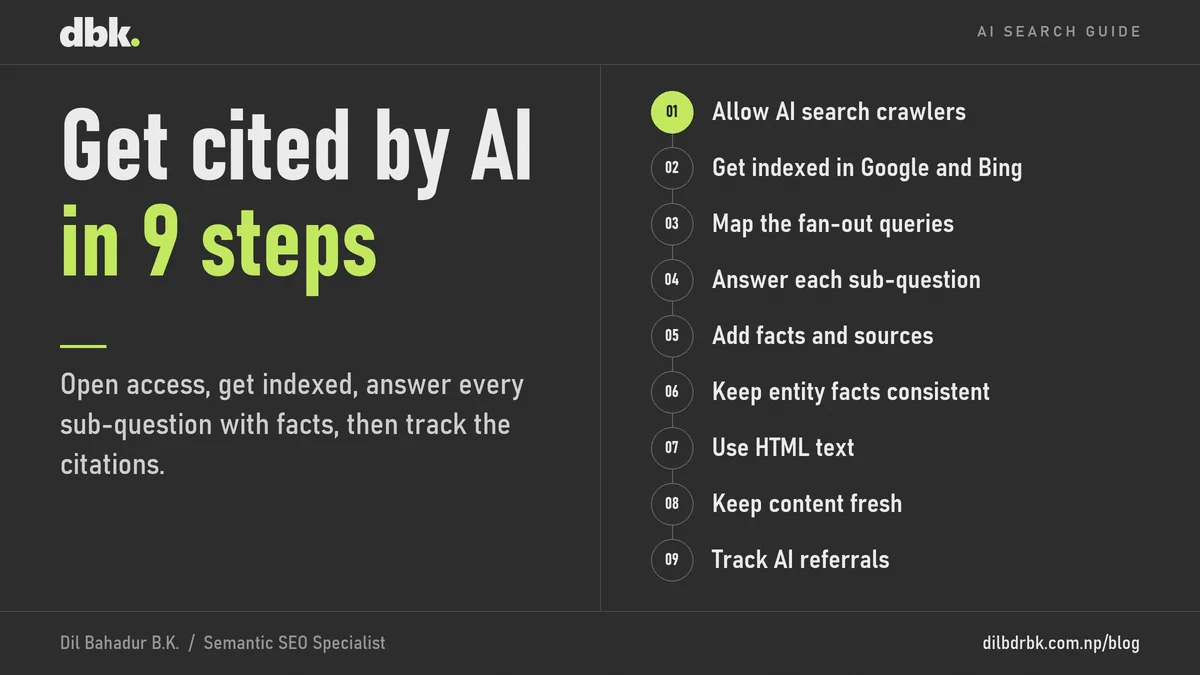
How to Get Cited by ChatGPT in 9 Steps
Getting cited by ChatGPT takes 9 steps that move from access to content to measurement. The same steps apply to AI Overviews, AI Mode, Perplexity, Claude and Copilot, because every engine retrieves before it cites.
Step 1: Allow the AI Search Crawlers
Allow the search crawlers of every AI engine in robots.txt, such as OAI-SearchBot, PerplexityBot, Claude-SearchBot, Googlebot and Bingbot. Blocking one of them removes the site from that engine's search answers, according to OpenAI, Perplexity and Anthropic.
Training crawlers are a separate decision. GPTBot, ClaudeBot and Google-Extended control model training, and Google states that Google-Extended does not affect inclusion or ranking in Google Search.
Step 2: Get Indexed in Google and Bing
Get every important page indexed in both Google and Bing, because Google's AI features use Google's index and Copilot uses Bing's index. Submit an XML sitemap in Google Search Console and Bing Webmaster Tools, and fix crawl errors, such as blocked or orphan pages.
Google states that a page must be indexed and eligible to show with a snippet to appear in AI Overviews or AI Mode. An unindexed page cannot be cited by any engine that relies on that index.
Step 3: Map the Fan-Out Query Network
List the sub-questions an AI engine is likely to search for each main topic, grouped by attribute, such as definition, cost, steps, comparison and risks. Google autocomplete, People Also Ask and Search Console queries show which sub-questions people already ask.
The query network becomes the plan for the page and its sections. Each sub-question gets a heading, and sub-questions with a distinct intent get their own page.
Step 4: Answer Each Fan-Out Sub-Question in Its Own Section
Put each sub-question in a heading and answer it in the first sentence underneath. Microsoft states that AI assistants break pages into smaller pieces, a process it calls parsing, and evaluate each piece for authority and relevance.
Use headings that name the question, such as "What does OAI-SearchBot do?", instead of vague labels, such as "Learn more". Microsoft adds that Q&A pairs, lists and tables give assistants clean pieces to lift into answers.
Step 5: Add Statistics, Quotations and Sources
Back claims with numbers, short quotations and named sources. The GEO study by Aggarwal and colleagues, published at KDD 2024, tested 9 methods on a benchmark of 10,000 queries and found that the best methods raised visibility in generative answers by up to about 40%.
Adding quotations, adding statistics and citing sources ranked among the strongest methods in that study. Keyword stuffing gave little or no improvement, so repeating a phrase does not earn citations.
Step 6: Keep Entity Facts Consistent
Keep the facts about a business identical across the site, its structured data and its profiles, such as the name, services, locations and founding date. Consistent facts let an AI engine match a page to the right entity and quote it with confidence.
Google states that structured data should match the content visible on the page. Organization or Person schema with sameAs links to official profiles ties the site to the same entity on other platforms.
Step 7: Publish Key Answers as HTML Text
Publish every key answer as visible HTML text, not only inside PDFs, images, tabs or expandable menus. Microsoft warns that AI systems may not render hidden content and that PDFs often lack the headings and metadata HTML provides.
Images and videos still add value next to the text. Google recommends high-quality images and videos that support the written content for AI experiences in Search.
Step 8: Keep Content Fresh and Dated
Update pages when their facts change and show the updated date on the page. Microsoft names fresh, authoritative, structured and semantically clear content as the starting point for selection in AI answers.
Date every statistic and price, such as "38% in March 2026", so an AI engine can judge whether the figure is current. A dated fact is also easier for a reader to verify.
Step 9: Track AI Referrals and Citations
Track AI visibility in three places: Search Console, analytics and the AI engines themselves. Google states that traffic from AI features is included in the Web search type of the Search Console Performance report.
Analytics tools usually record visits from AI assistants under their referrer domains, such as chatgpt.com and perplexity.ai. A monthly test of 10 to 20 important prompts in ChatGPT, Perplexity, AI Mode and Copilot shows which pages each engine cites.
What Does Not Get a Site Cited by AI?
Six common tactics do not get a site cited by AI, according to the platforms and research. The list explains each one.
- AI text files or special markup for Google: Google states that no new machine-readable files, AI text files or special schema are needed for AI Overviews or AI Mode.
- Keyword stuffing: the GEO study found little or no visibility gain from repeating keywords.
- Blocking search crawlers to protect content: blocking OAI-SearchBot or PerplexityBot removes the site from those engines' answers.
- Hiding answers in tabs, PDFs or images: Microsoft warns that AI systems may skip content they cannot parse or render.
- Commodity content: John Mueller of Google advised in May 2025 to focus on unique, non-commodity content for AI experiences in Search.
- Chasing one ranking only: Ahrefs found that about 38% of pages cited in AI Overviews rank in the top 10 for the same query, so a single top ranking covers only part of the searches an AI engine runs.
Each of these tactics targets the prompt or the crawler in isolation. Citations follow when a page is reachable, indexed and the clearest answer to one of the searches an AI engine runs.
How to Get Cited by ChatGPT FAQ
Does ChatGPT use Google or Bing for search?
ChatGPT uses third-party search providers plus OpenAI's own crawler, OAI-SearchBot. OpenAI's help center names the Microsoft privacy statement among the search provider policies, and Microsoft runs Bing.
Does blocking GPTBot remove a site from ChatGPT search?
No. GPTBot only controls whether content may train OpenAI's models, and OAI-SearchBot controls search visibility. OpenAI treats each setting as independent.
Do I need llms.txt to appear in AI Overviews?
No. Google states that sites do not need new machine-readable files, AI text files or special markup to appear in AI Overviews or AI Mode.
Do I need schema markup to get cited?
No, not for Google's AI features, which require no special schema.org types. Schema still helps machines read a page, and Microsoft describes structured data as a way for search engines and AI systems to understand content.
How long does it take for ChatGPT to cite a new page?
There is no fixed timeline. OpenAI states that its search systems adjust to a robots.txt change in about 24 hours, but a citation also depends on the page being indexed and matching the searches ChatGPT runs.
Does a number 1 Google ranking guarantee an AI Overview citation?
No. Ahrefs found in March 2026 that about 38% of pages cited in AI Overviews ranked in the top 10 for the same query, so many cited pages rank lower and many top pages go uncited.
Get Your Site Ready for AI Search
Getting cited by AI search turns this guide into a plan for one website. I deliver 3 outputs in this kind of project:
- Access audit: robots.txt, indexing in Google and Bing, and the crawl paths every AI engine needs
- Fan-out query map: the sub-questions of each core topic, assigned to a page or a section
- Citation-ready pages: answer-first sections with sourced facts, consistent entity facts and structured data
The work fits e-commerce stores, B2B companies and local service businesses, such as the 25+ industries on the Industries page.
References
Platform documentation:
- OpenAI, Overview of OpenAI Crawlers
- OpenAI Help Center, Searching the web with ChatGPT
- Google Search Central, AI features and your website, updated 10 December 2025
- John Mueller, Google Search Central Blog, Top ways to ensure your content performs well in Google's AI experiences on Search, 21 May 2025
- Elizabeth Reid, Google, AI in Search: Going beyond information to intelligence, 20 May 2025
- Google, Google's common crawlers: Google-Extended
- Google AI for Developers, Grounding with Google Search
- Krishna Madhavan, Microsoft Advertising, Optimizing Your Content for Inclusion in AI Search Answers, 8 October 2025
- Perplexity, Perplexity Crawlers
- Anthropic, Does Anthropic crawl data from the web, and how can site owners block the crawler?, 8 April 2026
Research and studies:
- Pranjal Aggarwal and colleagues, GEO: Generative Engine Optimization, KDD 2024
- Louise Linehan, Ahrefs, 38% of AI Overview Citations Pull From The Top 10, 2 March 2026
- Louise Linehan, Ahrefs, Only 12% of AI Cited URLs Rank in Google's Top 10 for the Original Prompt, 11 August 2025
- Simon Willison, Anthropic Trust Center: Brave Search added as a subprocessor, 21 March 2025
- Koray Tugberk Gubur, Holistic SEO, Topical Authority