
Topical Authority guide
Topical Authority vs Domain Authority: What Google Uses
Topical authority vs domain authority: one is how deeply a site covers a subject, the other an SEO tool score built from backlinks. See what Google uses.

Short answer
Topical authority is the depth and accuracy with which a website covers one subject, and domain authority is a score from 1 to 100 that SEO tools, such as Moz, calculate mainly from a site's backlinks. Google does not use Moz's Domain Authority or any other third-party score. Google does use links through PageRank and says that site-wide signals contribute to how it understands pages, so a site that ranks well needs both topical depth and relevant links.
Domain Authority is Moz's score from 1 to 100, built mainly from the number and quality of linking root domains, and Ahrefs Domain Rating, Semrush Authority Score and Majestic Trust Flow rate link strength the same way. Topical authority has no score. Holistic SEO defines it as a methodology to rank higher by covering connected topics and the queries they imply, and practitioners describe it through topical coverage and historical data.
Google stated in 2016 and 2019 that it has no website authority score and does not use Domain Authority, yet PageRank remains one of its core ranking systems and site-wide signals contribute to how it understands pages. Google's topic authority system surfaces expert sources for news by topic, research from 1999 to 2002 found that authority computed per topic ranked pages more accurately than one global score, and the 2024 leaked documentation lists site-level attributes for topic focus, such as siteFocusScore.
Topical depth carries the most weight for specific questions inside a niche, such as permit costs for one trek, and link strength carries more for broad, competitive searches. A site gains from both by planning a topical map, covering it answer-first, linking the pages into one network and earning links from relevant sites, such as trade associations, then tracking impressions across the topic's queries in Search Console.
In this guide
What Is the Difference Between Topical Authority and Domain Authority?
Topical authority describes how much expertise a website shows on one subject, and domain authority estimates how strong a whole domain's link profile is. The first is a property of the content and the way it connects, and the second is a number that an SEO tool computes from links.
The table compares the 2 concepts on 10 points.
| Point | Topical authority | Domain authority |
|---|---|---|
| What it describes | A site's depth, accuracy and connections on one topic | A domain's predicted ranking strength across all topics |
| Who defines it | SEO practitioners, such as Holistic SEO | SEO tool makers, such as Moz, Ahrefs and Semrush |
| Form | A concept, with no official score | A number, such as Moz Domain Authority from 1 to 100 |
| Main input | Topical coverage, entity facts, internal links and the site's history | Backlinks: the number and quality of linking domains |
| Scope | One topic or one segment of a site | The whole domain |
| Google's position | Google runs a topic authority system for news searches only | Google states it does not use Domain Authority |
| Closest Google signal | Relevance systems and site-wide classifiers | PageRank and other link analysis systems |
| How to raise it | Plan a topical map and cover it with accurate pages | Earn links from other trusted, relevant sites |
| How to check it | Search Console impressions across a topic's queries | The score in the tool that calculates it |
| Typical failure | Many thin pages on loosely related topics | Bought or irrelevant links that inflate the score |
Both columns describe real forces in search. A site about trekking in Nepal can hold a modest link profile and still cover the Everest Base Camp Trek better than a large travel portal, while the portal's links give each of its pages a stronger starting position.
What Is Topical Authority?
Topical authority is the expertise a website shows on one topic by covering its entities, attributes and questions accurately and linking those pages into one network. Holistic SEO describes it as a way to show a source's expertise on a topic by covering more entities, attributes and sub-topics with accurate information. A site with topical authority answers the main question of a topic and the follow-up questions, such as the cost, the risks and the alternatives.
Topical authority is a practitioner concept, not a Google metric. The topical authority entry in this website's glossary gives a short definition, and the guide to entity SEO explains the entities and attributes it rests on.
What Is Domain Authority?
Domain Authority, written with capitals, is a score developed by Moz that predicts how likely a website is to rank in search results compared with its competitors. According to Moz, the score ranges from 1 to 100, a machine learning model calculates it from link data, and the number of linking root domains is one of its most important inputs.
Written in lower case, domain authority often means the general idea of a strong domain, and SEO tools publish their own versions of it. Ahrefs calls its score Domain Rating, and Semrush calls its score Authority Score.
How SEO Tools Calculate Domain Authority
SEO tools calculate domain authority mainly from backlinks, and each tool uses its own link index and its own formula. The scores look alike, but a domain can hold different values in each tool because each one crawls a different set of links.
The table lists 4 common scores.
| Score | Tool | Scale | Main inputs |
|---|---|---|---|
| Domain Authority (DA) | Moz | 1 to 100 | A machine learning model over link data, led by the number and quality of linking root domains |
| Domain Rating (DR) | Ahrefs | 0 to 100 | The strength of a site's backlink profile compared with other sites in the Ahrefs database; each linking domain splits its rating evenly among the domains it links to |
| Authority Score (AS) | Semrush | 1 to 100 | Link power, estimated organic traffic and spam factors in the link profile |
| Trust Flow and Topical Trust Flow | Majestic | 0 to 100 | Links from a manually chosen set of trusted seed sites; Topical Trust Flow splits the score across more than 800 topic categories |
Majestic's Topical Trust Flow sits between topical authority and domain authority. It still counts links, but it reports which topic categories those links come from, such as travel or health.
What a Domain Authority Score Shows and What It Hides
A domain authority score shows a domain's link strength relative to other domains in one tool's index. Moz states that a new website always starts at a Domain Authority of 1, and that raising a score from 20 to 30 is easier than raising it from 70 to 80. Moz also says there is no universal good score, so the useful comparison is against the sites that compete in the same search results.
The score hides 3 things. It does not show which topics a site covers, it does not measure content quality, and it does not reflect Google's own view, because Moz states that Domain Authority is not a Google ranking factor and has no effect on search results. Moz offers a companion score, Page Authority, which predicts how well one specific page will rank, also on a scale from 1 to 100.
How Topical Authority Works
Topical authority works when a site covers a topic's entities, attributes and questions accurately, connects those pages with internal links and keeps the coverage current over time. No tool computes it as one number, so practitioners describe it through its parts: topical coverage, historical data and the structure of the topical map.
Topical Coverage and Historical Data
Topical coverage is the share of a topic that a site answers. Holistic SEO calls topical coverage a metric about the level and competence of a website on a topic, and states that Google tries to judge a website's expertise and trustworthiness with historical data. Practitioners describe historical data as the record of how users interact with a site over time, such as return visits and pages viewed per session.
Practitioners often summarize this as a formula: topical authority equals topical coverage multiplied by historical data. On the James Dooley podcast, Dooley credits Koray Tugberk Gubur with that formula, and some practitioners add a third term, the cost of information retrieval. The formula is a working model for planning, not a calculation that Google publishes.
Topical Maps, Core Sections and Internal Links
A topical map is the plan behind topical authority. It lists the central entity, its attributes and the questions people ask about them, and it decides which attributes earn their own page and which become a section on a parent page. In Koray Tugberk Gubur's framework, a topical map has a core section, close to what the business sells, and an outer section that covers the wider topic and supports the core.
Internal links turn the map into a network. Each page links to its parent topic and to closely related pages with anchors that name the target, such as a cost page that links to the permits page of the same trek. The topical map diagram on this website shows how attributes become pages or sections.
Free tool
Topical coverage checker
Pick a sample topic and tick each subtopic your site already answers on a page or in a section. The checker counts the core and the outer section of the topical map and lists the gaps. It counts coverage only; it is not a Google score.
Central entityEverest Base Camp Trek
0 of 12 subtopics covered (0%) Core 0 of 6, outer 0 of 6.
Start with the core section: those pages sit closest to what the site sells.
Each list is a sample built from common searches about the entity. A real topical map takes its subtopics from the site's own query network.
What Holistic SEO Reports From Its Case Studies
Holistic SEO reports large traffic gains from sites built on topical maps, and it presents topical authority as a way to improve rankings without backlinks. The main project on its topical authority page went from 0 to 128,000 organic traffic in 123 days, according to that page, and the same page also cites growth from 0 to 100,000 in 115 days.
These are self-reported case studies, not controlled experiments, and the 2 figures for the main project differ. They show what the method reached on specific sites, so this guide treats them as practitioner evidence rather than proof that links stop mattering.
What Google Says About Domain Authority and Site Authority
Google says it does not use Domain Authority and has no single authority score for websites, but it does use links through PageRank and it uses site-wide signals alongside page-level ones. The statements below come from Google employees and Google's own documentation, in date order.
- October 2016, no website authority score: in a Google Webmaster Central hangout, John Mueller said that Google does not have anything like a website authority score.
- October 2016, no overall domain authority: Gary Illyes of Google wrote on 27 October 2016 that Google does not really have overall domain authority.
- April 2019, Domain Authority not used: John Mueller wrote on 16 April 2019 that Google does not use domain authority, that it tries to keep its metrics as granular as possible and that it sometimes looks at things more broadly, such as in some older quality updates.
- PageRank still in use: Google's guide to its ranking systems describes PageRank as one of the core ranking systems used when Google first launched and states that it continues to be part of those core systems.
- Site-wide signals: the same guide, updated 10 December 2025, states that Google's ranking systems work on the page level and that site-wide signals and classifiers are also used and contribute to Google's understanding of pages.
- Host site signals: Google's spam policies define site reputation abuse as third-party content published on a host site mainly because of that host's established ranking signals, which the host earned from its first-party content.
The 6 statements fit together. Google rejects one domain-wide authority score, such as Moz's, yet it confirms link analysis and site-wide signals. The site reputation policy shows that a site's established signals can lift pages on it, which is why Google wrote a policy against borrowing them.
Google's Topic Authority System for News
Google documents one system that carries the name topic authority, and it applies to news. According to a Google Search Central post from 23 May 2023, the topic authority system helps determine which expert sources are helpful for news searches in specialized topic areas, such as health, politics or finance.
The post names 3 prominent signals:
- Notability for a topic or location: how relevant a publication is to a topic or a place, such as a local paper for the high school football of its city.
- Influence and original reporting: how often other publishers cite a publication's original reporting.
- Source reputation: a history of high-quality reporting or recommendations from expert sources, such as professional societies.
Google gives an example that fits the wider topical authority idea: after a local flood, the system helps surface publications from that region that regularly cover the area, even when larger national outlets cover the flood too. Google has not described a general topical authority score for all websites, so the system confirms the principle for news only.
What Google Says About Topical Authority
Google treats topical authority as a description of relevance, not as a separate score. In November 2023, John Mueller endorsed a Reddit comment that called topical authority a new name for relevancy, and he told SEOs not to worry about the term.
Google's guidance on helpful content asks related questions. Its self-assessment list asks whether a site has a primary purpose or focus, and it lists producing lots of content on many different topics, in the hope that some of it performs well, as a warning sign of search engine-first content.
What the 2024 Leaked Documentation Suggests
Internal documentation for Google's Content Warehouse API appeared on a public GitHub repository around 13 March 2024 and became widely known in May 2024. The documents described more than 14,000 attributes on over 2,500 pages, and Google confirmed on 29 May 2024 that they were authentic while cautioning against inaccurate assumptions.
Three attributes relate to this comparison:
- siteAuthority: an attribute that appears to represent a site-level authority score.
- siteFocusScore: an attribute that measures how much a site focuses on one topic.
- siteRadius: an attribute that measures how far individual pages move away from the site's main topic, based on embeddings.
The attributes suggest that Google stores site-level quality and topic-focus data, but the documents do not say how much any attribute weighs in ranking or whether it is still in use. Google told Search Engine Land that individual signals can change often, be dropped, or be tested and never used, so this guide treats the leak as context, not as a confirmed mechanism.
What Research Shows About Topic-Specific Authority
Information retrieval research has measured authority per topic for more than 25 years, and the studies found that topic-specific authority ranks pages more accurately than one global score. The research supports the idea behind topical authority, though it does not show which method Google runs today.
The 3 best-known studies are:
- HITS, 1999: Jon Kleinberg's paper "Authoritative Sources in a Hyperlinked Environment" in the Journal of the ACM split pages into hubs, which link to many good pages on a topic, and authorities, which many good hubs link to. The algorithm computes these scores for the pages around one query, so authority depends on the topic.
- Hilltop, 2001: Krishna Bharat and George Mihaila built a ranking method on expert documents, pages about a topic that link to many unaffiliated pages on that topic. With an index of 2.5 million expert pages out of about 140 million in the AltaVista index, the method performed comparably on popular queries with the best mainstream search engines of the time.
- Topic-Sensitive PageRank, 2002: Taher Haveliwala computed 16 separate PageRank vectors, each biased toward one top-level category of the Open Directory Project. In a user study with 5 volunteers and 10 queries, the topic-sensitive rankings were preferred for 8 of the 10 queries, and the paper reports more accurate rankings than a single, generic PageRank vector.
The common thread is that a link means more when it comes from a page about the same topic. That finding sits behind practical advice on topical authority and on topic-relevant link building.
Topical Authority vs Domain Authority: Which Matters More?
Neither one replaces the other. Topical authority decides whether a site's pages are relevant and complete for a subject, and link strength, which domain authority scores estimate, helps decide which of the relevant pages ranks first. The balance shifts with the type of search and the competition.
The table summarizes where each one tends to carry more weight. It reflects the Google statements and research above, and it is an interpretation, not a published Google rule.
| Situation | Topical authority | Link strength |
|---|---|---|
| Specific questions inside a niche, such as permit costs for one trek | Carries more weight | Helps |
| Broad, competitive head terms, such as "travel insurance" | Required to compete | Carries more weight |
| Local news and local services | Carries more weight, as Google's news example shows | Helps |
| A new site with few links | The part the site controls from day one | Starts at 1 in Moz's Domain Authority |
| Topics where accuracy affects health or money | Required, together with clear sources | Helps when links come from trusted sources in the field |
When Topical Authority Gives a Smaller Site the Edge
Topical depth carries the most weight for specific, multi-part topics where general sites cover only the headline question. A focused site that answers the costs, permits, seasons and risks of the Everest Base Camp Trek (Wikidata Q1950455) gives searchers more answers than a broad travel portal with one overview page.
Google's own news example points the same way: its topic authority system lifts regional publications that regularly cover an area above larger national outlets for local news. Google's ranking systems guide also states that its site diversity system generally shows no more than 2 listings from the same site in the top results, which leaves room for other relevant sites.
When Links and Domain Strength Still Decide
Link strength carries more weight for broad, competitive searches, such as "credit cards" or "hotels", where many sites cover the topic well. PageRank remains a core ranking system, so among pages of similar relevance, the page with stronger and more relevant links has an advantage.
The site reputation policy shows the same force from the other side. Google describes third-party pages placed on established host sites to rank better than they could on their own, and it treats such placements as a spam policy violation.
How to Build Topical Authority in 7 Steps
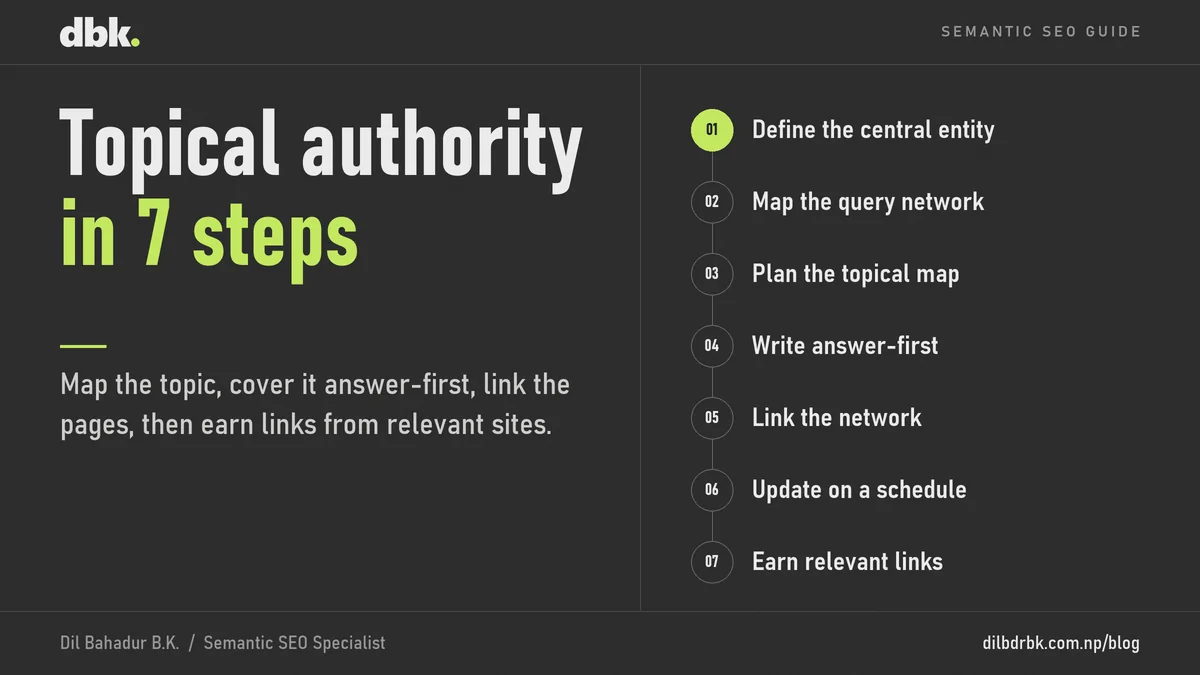
Build topical authority in 7 steps: define the central entity, map its query network, plan the topical map, write answer-first pages, link the pages into a network, update them on a schedule and earn links from relevant sites. Each step produces an output that the next step uses.
Step 1. Define the Central Entity and the Source Context
Name the main entity the site covers and the reason the site exists, such as a trekking agency in Nepal that sells guided treks. The central entity sets the topic, and the source context decides which angle of the topic the site owns.
Step 2. Map the Query Network
Collect the questions people ask about the entity from Google Search Console, Google autocomplete and People Also Ask, such as "everest base camp trek cost" and "best time for everest base camp trek". Group them by attribute, such as cost, season, permits and difficulty.
Step 3. Plan the Topical Map
Give an attribute its own page when it has its own search demand and a distinct result type, and cover it as a section on a parent page when it does not. Put the attributes closest to the business, such as trek packages and prices, in the core section, and the wider questions, such as altitude sickness, in the outer section.
Step 4. Write Answer-First Pages With Entity Facts
Open each page and section with a direct answer, then add the facts the entity needs, such as distances in kilometres and miles, prices with a date and permits with their issuing body. The page anatomy diagram shows the parts of a page that answers one clear question.
Step 5. Link the Pages Into One Network
Link each page to its parent topic and to its closest related pages with descriptive anchors that name the target. Google's link guidance asks for anchor text that is descriptive, reasonably concise and relevant to both pages.
Step 6. Update the Coverage on a Schedule
Review prices, dates and rules on a fixed schedule, such as every quarter, and add pages when new questions appear in Search Console. Holistic SEO describes an update score built from update frequency and update amount, which ties fresh coverage to topical authority.
Step 7. Earn Links From Relevant Sites
Earn links from sites in the same field, such as travel publications, trekking associations and local tourism pages, with assets those sites want to cite, such as original data or a clear permit guide. Relevant links strengthen both sides: they pass PageRank and they come from pages about the same topic.
How to Raise Domain Authority Without Chasing the Score
Raise domain authority by earning links that Google values, and treat the tool score as a side effect. A score that rises through bought or irrelevant links can mislead the site owner and breach Google's spam policies at the same time.
Four habits raise link strength in a way that also supports topical authority:
- Publish link-worthy assets: original data, tools and clear guides, such as a yearly permit cost table, give other sites a reason to link.
- Prefer relevant linking sites: a link from a trekking association says more about a trekking site than a link from an unrelated directory, as the research on topic-sensitive authority suggests.
- Build mentions in the field: interviews, expert quotes and listings in professional bodies, such as a tourism board, create links and citations from trusted sources.
- Avoid link schemes: Google's spam policies treat links intended to manipulate rankings, such as bought links that pass PageRank, as link spam.
The off-page SEO service on this website follows the same rule: links come from relevant sources, and the score in a tool is never the target.
Common Mistakes When Comparing Topical Authority and Domain Authority
Watch for 7 mistakes when a site plans around topical authority and domain authority:
- Treating a tool score as Google's view: Moz, Ahrefs and Semrush scores estimate link strength, and Google states it does not use them.
- Buying links to lift a score: links bought to pass PageRank violate Google's spam policies, even when they raise a tool score.
- Ignoring links entirely: PageRank is still a core ranking system, so topical coverage alone may not win broad, competitive searches.
- Publishing on too many unrelated topics: Google's helpful content guidance lists content on many different topics, made in the hope that some of it performs well, as a warning sign.
- Writing many thin pages for one topic: coverage means answering each attribute well, not creating a page for every keyword variant.
- Renting space on a strong host site: third-party pages placed on a host to borrow its ranking signals fall under Google's site reputation abuse policy.
- Reading the leaked attributes as rules: siteFocusScore and siteAuthority show what Google stored in 2024, not how much each one weighs today.
How to Measure Topical Authority and Domain Authority
Measure topical authority through search visibility across a topic's queries, and measure domain authority through link data and tool scores. The table lists 6 measurements and the tool for each.
| What to measure | Tool | What it shows |
|---|---|---|
| Impressions and clicks across all queries of one topic | Google Search Console Performance report, filtered by a topic folder or a query term | Whether Google shows the site for more questions in the topic over time |
| Topical map coverage | A topical map in a spreadsheet | The share of planned attributes that have a published page or section |
| Rankings for a topic's query set | A rank tracker | Whether the site gains positions across the whole cluster, not only for one keyword |
| Linking root domains and their topics | Moz, Ahrefs, Semrush or Majestic | How many sites link to the domain and which fields they come from |
| Domain authority scores of competitors | The same tool for every site | Link strength relative to the sites in the same search results |
| Mentions in AI answers | Manual checks in AI Overviews, AI Mode and AI assistants, such as ChatGPT | Whether the site appears as a source for questions in its topic |
Compare tool scores only within one tool, because DA, DR and AS use different indexes and formulas. A growing number of non-brand queries per topic in Search Console is the clearest sign that topical authority is growing.
Topical Authority vs Domain Authority FAQ
Does Google use domain authority?
No. John Mueller of Google wrote in 2019 that Google does not use domain authority, and Moz states that its Domain Authority is not a Google ranking factor. Google does use links through PageRank and uses site-wide signals alongside page-level signals.
Is topical authority a Google ranking factor?
No, not as a named factor. Google runs a topic authority system for news searches in specialized areas, and its documentation and the 2024 leaked attributes point to site-level topic signals, but Google has not described a general topical authority score.
What is a good domain authority score?
There is no universal good score. Moz states that Domain Authority is a relative metric, so a score of 30 can be strong in one industry and weak in another, and the useful comparison is against the sites that rank for the same searches.
What is the difference between Domain Authority and Page Authority?
Domain Authority predicts how well a whole website can rank, and Page Authority predicts how well one specific page can rank. Moz calculates both on a scale from 1 to 100 with machine learning models built on its link index.
What is the difference between Domain Authority and Domain Rating?
Domain Authority is Moz's score, and Domain Rating is Ahrefs' score. Both rate link strength on a 100-point scale, but each uses its own link index and formula, so the same site gets different numbers in each tool.
Can a new website build topical authority?
Yes. A new website starts at a Domain Authority of 1 in Moz, but it can cover a topic completely from its first months. Topical coverage is the part of authority that a new site controls from day one, and links tend to follow useful coverage over time.
Does topical authority matter for AI search?
Yes, through the same systems. Google states that AI Overviews and AI Mode are rooted in its core Search ranking and quality systems, and that a page must be indexed and eligible to show with a snippet to appear as a supporting link. A site that covers a topic's questions clearly has more pages that can answer those searches.
Get a Topical Map for Your Site
A topical map turns the topical authority vs domain authority comparison into a plan for one website. I deliver 3 outputs in this kind of project:
- Query network: the questions people ask about the central entity, grouped by attribute and intent
- Topical map: a page-or-section decision for every attribute, split into a core section and an outer section
- Link plan: the internal links between pages and the relevant external sources worth earning links from
The work fits local service businesses, e-commerce stores and B2B companies, such as the 25+ industries on the Industries page.
References
Google documentation and statements:
- Google Search Central, A guide to Google Search ranking systems, updated 10 December 2025
- Google Search Central, Spam policies for Google web search, updated 28 August 2026
- Google Search Central, Link best practices for Google, updated 10 December 2025
- Google Search Central, Creating helpful, reliable, people-first content, updated 5 October 2026
- Google Search Central, Optimizing your website for generative AI features on Google Search
- Google Search Central Blog, Understanding news topic authority, 23 May 2023
- John Mueller, Google Webmaster Central hangout, October 2016
- Gary Illyes, post on overall domain authority, 27 October 2016
- John Mueller, post on domain authority, 16 April 2019
- John Mueller, Reddit comments on topical authority (first, second), November 2023
- Search Engine Land, Google responds to leak: documentation lacks context, May 2024
- Wikipedia, 2024 Google Search documentation leak
Research papers:
- Jon Kleinberg, Authoritative Sources in a Hyperlinked Environment, Journal of the ACM, 1999
- Krishna Bharat and George Mihaila, When Experts Agree: Using Non-Affiliated Experts to Rank Popular Topics, WWW 2001
- Taher Haveliwala, Topic-Sensitive PageRank, WWW 2002
SEO tool documentation and practitioner sources:
- Moz, Domain Authority, updated 18 March 2025, and Page Authority, 18 November 2024
- Ahrefs, What is Domain Rating (DR)?
- Semrush, Authority Score
- Majestic, Topical Trust Flow
- Koray Tugberk Gubur, Holistic SEO, Topical Authority
- James Dooley Podcast, The Topical Authority Formula Explained