
Google Updates guide
What Is a Google Core Update and How Do You Recover From One?
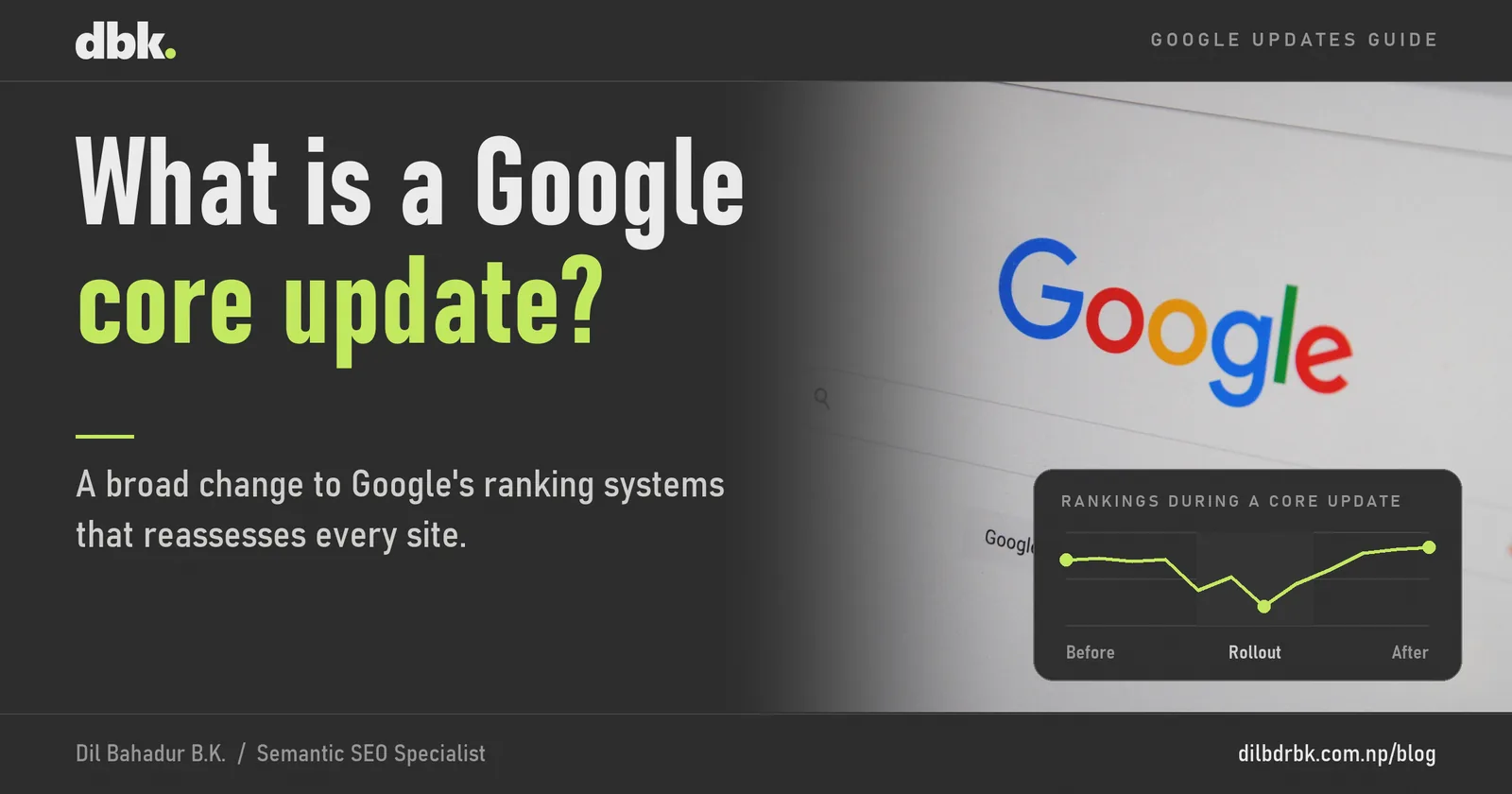
A Google core update is a broad change to Google's ranking systems that reassesses every site, shifts rankings and rewards helpful content.

Short answer
A Google core update is a broad change to Google's search algorithms and systems that reassesses how pages rank, and Google releases one several times a year. It targets no specific site or page, so a drop after a core update often reflects other content looking more helpful, not a broken rule. Recovery depends on improving the content itself, and Google says the effect can take a few days to several months to show.
Google's Search Status Dashboard lists 10 core updates between March 2024 and November 2026, and finished rollouts lasted from 6 to 45 days. The November 2026 core update started on 10 November 2026 with a rollout window of up to 2 weeks, and it had not finished on 15 November 2026.
A site checks the impact in 4 moves: confirm the rollout dates, wait one more week, compare a week after with a week before, and split the data by search type. Google advises no drastic action for a small drop, such as position 2 to 4, and a deeper assessment for a large drop, such as position 4 to 29.
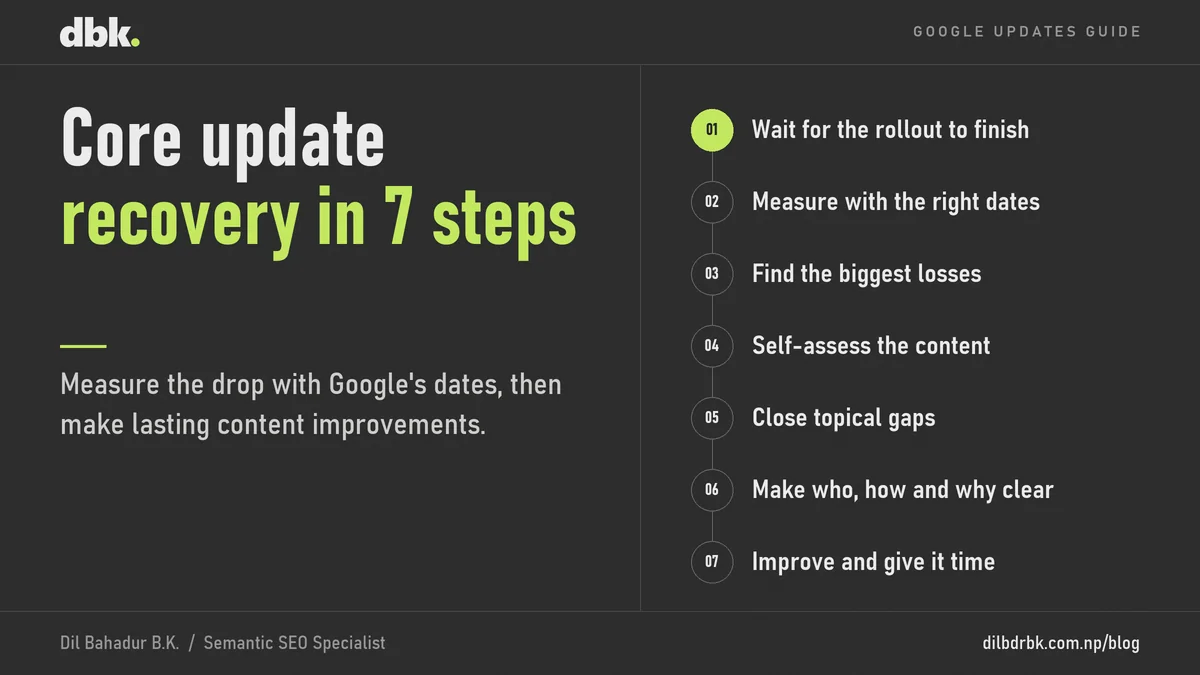
Recovery then follows 7 steps, from waiting out the rollout to closing topical gaps and making who, how and why clear on every page. Google warns against quick fixes, and it calls deleting content a last resort.
In this guide
What Is a Google Core Update?
A Google core update is a significant, broad change to Google's search algorithms and systems. Google Search Central states that it makes these changes several times a year and gives notice of each one on its list of ranking updates, the Search Status Dashboard.
Google designs core updates to present helpful and reliable results for searchers. Its core updates documentation, last updated on 10 December 2025, says the changes are broad in nature and do not target specific sites or individual web pages.
Core ranking systems are the underlying technologies that produce search results, as Google's ranking systems guide defines them. A core update changes these systems as a whole, which is why sites in many niches move at the same time.
Core Updates vs Spam Updates vs Smaller Core Updates
Three kinds of ranking change matter most after a drop, and each one calls for a different response. The table separates them.
| Update type | What changes | What Google advises |
|---|---|---|
| Core update | Broad changes to the core ranking systems, announced on the Search Status Dashboard | Self-assess content quality and avoid quick fixes |
| Spam update | Improvements to automated spam detection, such as SpamBrain, Google's AI-based spam-prevention system | Review the spam policies, knowing any improvement may take months |
| Smaller core update | Ongoing changes that Google does not announce because they are not widely noticeable | Keep improving, because gains can show between major updates |
A spam update has its own recovery path. Google states that changes may help once its systems learn over months that a site follows the spam policies, while benefits from spammy links stay lost.
How Often Does Google Release Core Updates?
Google releases core updates several times a year, and recent years have brought 3 or 4. The Search Status Dashboard lists 4 core updates in 2024, 3 in 2025 and 3 so far in 2026.
Rollout length varies widely between updates. The March 2024 core update took 45 days, the longest in the chart, while the December 2024 core update finished in 6 days and 4 hours.
How long did recent core updates take to roll out?
The March 2024 core update also widened what core ranking covers. Google's ranking systems guide states that the helpful content system became part of the core ranking systems in March 2024, as the Panda system did in 2015 and the Penguin system did in 2016.
The November 2026 Core Update: What Google Has Confirmed
Google released the November 2026 core update on 10 November 2026, and it applies globally and to all languages. The Search Status Dashboard logged the start at 10:06 Pacific time and gave a rollout window of up to 2 weeks.
Google's announcement on LinkedIn, quoted by Search Engine Roundtable, called it a regular update designed to better surface relevant, satisfying content for searchers from all types of sites. Google named no narrower target, such as a content type or an industry, so any claim about what this core update rewards stays a guess until the rollout ends.
It is the third core update of 2026, after the March 2026 core update (12 days and 4 hours) and the May 2026 core update (11 days and 21 hours). The dashboard also lists 4 spam updates in 2026 before it, in March, June, August and September.
Is the November 2026 Core Update Finished?
No, not as of 15 November 2026. The Search Status Dashboard still showed the November 2026 core update as in progress on that date, and a full 2-week rollout would end around 24 November 2026.
Past rollouts ran from 6 to 45 days, so the dashboard's completion note is the date to trust. Google advises waiting until the rollout completes, and a further week, before analyzing any data, since rankings can still shift during a rollout.
How Does a Core Update Affect Rankings?
A core update affects rankings by reassessing content across the web, so some pages rise and others fall without any penalty. Google's debugging guide states that after an algorithmic update there might not be anything fundamentally wrong with a site's content.
Why Rankings Drop After a Core Update
Rankings drop after a core update for 3 common reasons, two from Google and one from practitioners, and Google does not say which one applies to a given site. The list shows each reason.
- Other pages help searchers more: Google's core updates documentation notes that other pages on the web may be doing a better job of helping the searcher.
- The site's content was reassessed: Google points sites that lost ground to its self-assessment questions on helpful, reliable, people-first content.
- Topical relevance was recalculated: Koray Tugberk Gubur of Holistic SEO argues that a broad core update can change a site's overall relevance radius and redistribute its positions across query clusters along topical borders. This is a practitioner interpretation, not a confirmed Google mechanism.
Is a Core Update a Penalty?
No, a core update is not a penalty, because Google states that core updates do not target specific sites or individual pages. What SEOs call a penalty is usually a manual action, which follows human review of a spam policy violation and appears in the Manual Actions report in Search Console.
How to Check if a Core Update Affected Your Site
A site checks core update impact in Search Console after the rollout ends, using a 4-part method based on Google's documentation. The method keeps normal ranking movement from being mistaken for an update effect.
- Confirm the dates: Check the Search Status Dashboard for the start and end date of the core update.
- Wait one full week: Google recommends waiting at least a full week after a core update completes before analyzing a site in Search Console.
- Compare matching weeks: Compare the week after that wait with a week before the rollout started.
- Split by search type: Analyze Web Search, Google Images, Video mode and the News tab separately to find where the drop happened.
Google's debugging guide adds a longer view. Set the date range to the last 16 months to rule out a yearly pattern, such as a holiday peak, and check whether the change hit specific queries, pages, countries or devices.
Small Drop vs Large Drop After a Core Update
Google treats a small drop and a large drop differently, and the size of the drop sets the response. The table uses Google's own examples.
| Drop size | Google's example | Google's advice |
|---|---|---|
| Small drop | Position 2 to 4 | No drastic action, and no changes to content that already performs well |
| Large drop | Position 4 to 29 | A deeper assessment of the whole site, not only single pages |
Position alone is a weak measure. Google's debugging guide says impressions and clicks are ultimately the measure of success, so a page that slips one position but keeps its clicks needs no rescue.
Other Causes That Look Like a Core Update Drop
A traffic drop during a core update rollout does not prove that the update caused it. Google's debugging guide lists 5 other causes to rule out.
- Technical issues: Errors that stop Google from crawling, indexing or serving pages, such as server availability problems or robots.txt fetch failures.
- Security issues: Threats, such as malware or phishing, that make Google warn users before they reach the site; the Security Issues report shows them.
- Spam issues: Spam policy violations that automated systems or human reviewers detect; the Manual Actions report lists manual actions.
- Seasonality and changing interests: Shifts in demand, such as a seasonal peak or a new trend, which Google Trends can confirm.
- Site moves and migrations: Changes to existing URLs, which cause ranking fluctuations while Google recrawls and reindexes the site.
How to Recover From a Google Core Update in 7 Steps
Recovery from a core update depends on lasting content improvements, not on quick fixes. Google advises changes that make sense for users and are sustainable in the long term, and the 7 steps follow that advice.
Step 1: Wait for the Core Update Rollout to Finish
Hold all changes until Google marks the core update complete, since rankings can still shift during the rollout and Google advises analyzing only after it ends. Koray Tugberk Gubur makes a related point in his analysis of the unannounced Phantom update, where he writes that a rash reaction would not have helped and that long-term improvement matters more.
Step 2: Measure the Drop With the Right Dates
Compare a full week, starting one week after the rollout ends, with a week before the rollout began. Record clicks, impressions and average position for the whole site, then decide whether the drop is small or large.
Step 3: Find the Pages and Queries That Lost the Most
Sort the Search Console comparison by the change in clicks, for pages and for queries. Google advises evaluating the pages that were most impacted, and a pattern, such as one content type or one topic cluster losing most, points to the cause.
Step 4: Self-Assess Content With Google's Questions
Read each losing page against Google's questions on helpful, reliable, people-first content, last updated on 5 October 2026. The questions ask, for example, whether the content offers original information, reporting, research or analysis, and whether it has easily verified factual errors.
Compare each losing page with the pages that now outrank it. Note what the winners cover that the losing page does not, such as a missing answer, a newer figure or a deeper treatment of a subtopic.
Step 5: Close Topical Gaps Around Your Central Entity
Map what the site covers against the full topic, then add or merge pages to fill the gaps. A topical map lists the attributes and questions around a central entity, and each missing node becomes a candidate page or section.
Koray Tugberk Gubur ties historical data and topical authority to how a source ranks after re-ranking, and he describes a quality threshold that documents pass to protect their rankings. These are practitioner interpretations, and the comparison of topical authority and domain authority separates them from what Google confirms.
Step 6: Make Who, How and Why Clear on Every Page
Show who wrote each page, how it was made and why it exists. Google's helpful content guidance asks whether authorship is self-evident to visitors, whether the use of automation, including AI generation, is disclosed, and whether the content exists primarily to help people.
Trust carries the most weight in this check. Google states that E-E-A-T itself is not a specific ranking factor, that trust is its most important part, and that its systems give even more weight to strong E-E-A-T on Your Money or Your Life topics, such as health and financial stability.
An author page with Person schema and matching profiles states the who in a form machines can read. The guide to entity SEO covers that method.
Step 7: Improve, Then Give Google Time
Publish the improvements, then check Search Console again after a few weeks, as Google's debugging guide suggests. Google states that some changes take effect in a few days, while others take several months for its systems to confirm.
Recovery is not guaranteed. Google's debugging guide says no change guarantees a noticeable impact, and that more deserving content will continue to rank well.
Free tool
Core update recovery checker
Pick the size of your drop and tick each check you have done. The checker counts diagnosis and content checks and lists the next ones. It tracks your process only: it is not a Google score, and no checklist guarantees a recovery.
Drop sizeSmall drop (such as 2 to 4)
0 of 12 recovery checks covered (0%) Diagnosis 0 of 6, content 0 of 6.
Start with the diagnosis checks: Google advises measuring the drop before changing anything.
Most checks follow Google's core update, traffic-drop and helpful content documentation, and the topical gap check is a practitioner method. Google gives the position examples as illustrations, not fixed thresholds.
How Long Does Core Update Recovery Take?
Core update recovery takes from a few days to several months, according to Google, and some sites see no change until the next core update. Google's core updates documentation states that its systems may need several months to learn and confirm that a site as a whole now produces helpful, reliable, people-first content.
A site does not always have to wait for the next major release. Google states that it runs smaller core updates that it does not announce, and these can raise the position of content that has improved in the meantime.
Google's documentation gives 4 timeframes for this stage. The table lists each one.
| Stage | Timeframe Google gives |
|---|---|
| Analyzing the drop | At least a full week after the rollout completes |
| Rechecking after changes | A few weeks, in Search Console |
| Some changes taking effect | A few days |
| Confirming site-wide improvement | Several months, or the next core update |
Core updates can also undo each other. Koray Tugberk Gubur writes that another broad core update can reverse the effect of an earlier one, and that a site can win a core update even after a period of lost traffic.
Common Core Update Mistakes
Most core update mistakes come from reacting too fast or measuring the wrong dates. The list shows 7 mistakes, and Google's guidance warns against most of them.
- Changing pages mid-rollout: Rankings can still shift until the update completes, which hides the real effect.
- Making quick fixes: Google gives the example of removing a page element because someone heard it was bad for SEO.
- Deleting content first: Google calls deleting content a last resort, only for content that cannot be salvaged.
- Comparing the wrong weeks: A week inside the rollout mixes old and new rankings.
- Chasing absolute position: Clicks and impressions measure success, not a single position.
- Rewriting pages that held up: Google advises against changing content that already performs well after a small drop.
- Treating the drop as a penalty: A core update targets no specific site, so there is no penalty to appeal, unlike a manual action in the Manual Actions report.
Each mistake either blurs the measurement window or changes pages that Google has not judged weaker. Holding changes until the data settles keeps the diagnosis clean and the next comparison fair.
Google Core Update FAQ
How many Google core updates were there in 2025?
Google released 3 core updates in 2025, according to the Search Status Dashboard: on 13 March, 30 June and 11 December. Their rollouts took about 14, 17 and 18 days.
When will the November 2026 core update finish?
Google gave a rollout window of up to 2 weeks from 10 November 2026, which points to around 24 November 2026. Finished core updates since 2024 ran from 6 to 45 days, so the completion note on the Search Status Dashboard is the date to rely on.
Should I make changes while a core update is rolling out?
No, wait until the rollout ends. Rankings can still shift until the update completes, and Google recommends waiting at least a full week after that before analyzing the site.
Can a site recover before the next core update?
Yes, a site can recover between major core updates. Google states that its smaller core updates are not announced but can raise the position of content that has improved.
Does Google say why a site dropped after a core update?
No, Google gives no site-level reason for a core update drop, because the update does not target specific sites. A manual action works differently, and Search Console's Manual Actions report lists it.
Do core updates target AI-generated content?
Google has not said that the November 2026 core update targets AI-generated content. Its helpful content guidance asks whether the use of automation, including AI generation, is clear to visitors and whether the content exists to help people.
Recover From a Core Update With a Semantic SEO Plan
A core update recovery plan reaches the structure behind the content, not only single pages. I audit the pages and queries that lost ground, map the topical gaps around your central entity, and outline the pages and updates that close them.
The work fits local service businesses, e-commerce stores and B2B companies. It also draws on the entity signals in the Google Knowledge Graph guide, so the who behind each page is clear.
References
Google documentation and statements:
- Google Search Central, Google Search's core updates and your website, updated 10 December 2025
- Google Search Central, Google Search spam updates and your site, updated 10 December 2025
- Google Search Central, Debugging drops in Google Search traffic, updated 10 December 2025
- Google Search Central, Creating helpful, reliable, people-first content, updated 5 October 2026
- Google Search Central, A guide to Google Search ranking systems, updated 10 December 2025
- Google Search Status Dashboard, Ranking update history and November 2026 core update
News coverage:
- Barry Schwartz, Search Engine Roundtable, Google November 2026 Core Update Rolling Out, 10 November 2026
- Matt G. Southern, Search Engine Journal, Google's November 2026 Core Update Starts Rolling Out, 10 November 2026
Practitioner sources:
- Koray Tugberk Gubur, Holistic SEO, Importance of Initial-Ranking, Re-ranking, and Historical Data for SEO
- Koray Tugberk Gubur, Holistic SEO, Google Phantom Update: Everything You Need to Know